|

By Doron Markowitz
Hello again, and welcome to another installment
of Luthier’s
Corner. For this month’s interview, I was honored with
the opportunity to speak with John Page, owner and builder of
John Page Guitars, and former head of the Fender Custom Shop
and Guitar R&D.
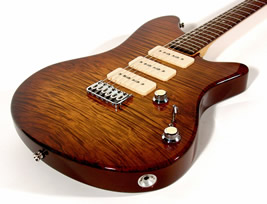
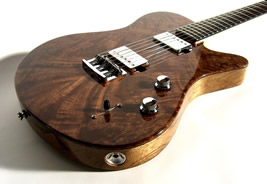
I have included some pictures of his work so you can see what
I mean. His work is extraordinary and I learned so much about
him and his craft through the course of this discussion.
Hello John, and thank you very much for taking the time to sit
with me to talk about the art of lutherie. I appreciate your
time. First off, let me say that it is an honor to be corresponding
with you like this! Tell me a little bit about how you got started
crafting guitars.
Did
you do any other type of wood working before beginning
to craft guitars?
I started building all kinds of things when I was a kid.
We didn’t have much money in my family, so if there
was something I wanted chances are I would have to build
it… guitars, surfboards, jewelry, whatever. The only
formal woodworking training I received was a half of a semester
in Junior High School. I also designed and built custom art
furniture while I was building guitars. It allowed me to
take ideas that wouldn’t fit into my guitars into my
furniture.
What was it that
made you decide to devote your life to crafting instruments?
I built my first guitar because I couldn’t afford
to buy a good one. I got into bands, I was passionate about
music, so it just kind of happened. I loved working with
my hands, I loved building guitars. My grandfather was
a pipe organ builder… maybe it was in my blood.
Did you find that
the guitars on the market lacked something that you thought
you could improve upon, which made you decide to become
a luthier?
Back when I started building I had no idea if the industry needed anything or
not. I just wanted to build. After several years at Fender it was obvious what “we” needed… custom
instrument capabilities. That ultimately led to the development of the Fender
Custom Shop |
|
 |
How
long have you been crafting stringed instruments?
I built my first guitar from scratch when I was fifteen
years old… that was 40 years ago. I dinked around
with modifying guitars a couple of years before that though.
Man… forty years… it’s a bit scary to
say!
What do you look
for in tone woods?
Well there are several things… first off I need
to make sure that the wood species, and the actual piece
itself, are structurally capable of doing the job I need
it to do. Next I want to make sure the piece has a nice
resonance to it… that it has an acoustic “life” when
activated. A dull or dead sounding piece of wood will result
in an inferior sounding instrument. Lastly I’ll consider
its aesthetic appeal.
Are there things
unrelated to the guitar that inspires a new idea or concept
that you incorporate into guitar building, like certain
architecture, or nature, etc?
Absolutely! Most of my inspiration comes from old cars
and cool buildings. Art is art… wherever it’s
used! |
Where
do you draw inspiration from for some of your builds?
Well, as I said above, some of it comes from cool old cars
or buildings. I’ll see a line, or a series of lines,
and think “wow… that’d be amazing on a
guitar body!” Other times it might be a musician I
hear or see… where the power of their performance
inspires me to create a guitar. I’ve got a bunch of
them still stirring around in my head… it’s
just hard to find the time to build them all!
What is your philosophy
in regards to guitar crafting?
I want to create instruments that inspire their owner to
be as creative as they can be… timeless instruments
that can last generations. I am not interested in building
topical guitars that are hip for a few years and then are
discarded. My goal is to make inspirational heirlooms.
I noticed that handcrafted guitars
are equal parts instrument and artwork/sculpture. How long
did it take you to hone your carving skills, and what was
the most difficult carving you have done to date?
I don’t consider my guitar building skills to be “carving”,
so I’m not sure what you’re thinking of here.
If you’re thinking about my art pieces, like “Woman
is the Machine” that is a style I’ve been working
of for many years with my non-guitar art… like my
art furniture and sculpture. |
|
|
How
long does it typically take you to build a guitar for
an average client?
My process takes about 100 hours over the course of at least
nine months.
Is the entire guitar
handcrafted, or do you use CNC machines for any part?
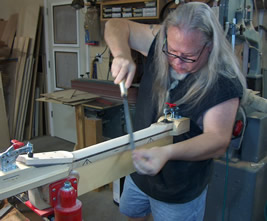
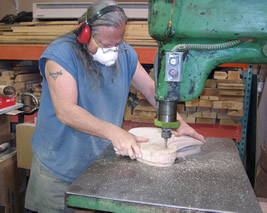
I do not use CNC machines, just classic woodworking tools… band
saw, hand routers, pin router, drill press and sanders.
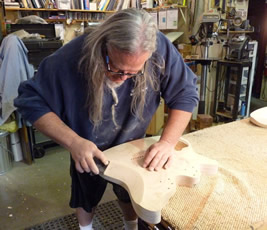
All my wood finish sand, as well as all of my finish paint
sanding, is done by hand with a block… no power
sanders. I feel I can get a much better and flatter surface
that way. I can also maintain an almost perfectly consistent
edge radius. It’s tough on the arms but I feel it’s
important.
Being a luthier
myself, I find that I love the smell of exotic woods
as I cut and shape them. What are some of your favorite
species of woods, scent-wise?
Hands down Port Orford Cedar! I remember when I picked
up my first batch of it and brought it in my shop. The
only way I could describe it was “It smelled like
god walked in the room”… it was amazing! |
What
are some of your favorite species of woods to work with,
carving-wise?
Again, I’m not real sure what you mean “carving-wise”.
Right now I’m really partial to Port Orford Cedar,
Black Limba, and some amazing feather crotch Walnut I picked
up… beautiful stuff!
Have you ever encountered
a project that seemed too much of a challenge for you
to take on?
I have a real problem saying “no” to anything.
I have pretty much always believed I can do anything, and
I usually can. Unfortunately I usually lose tons of money
on those projects too!
For anyone out there,
thinking of a career in lutherie, what kind of advice
would you give them?
Read everything you can find on guitar building, ask every
builder you meet lots of questions, and buy some wood and
start cutting! Experimentation is everything in this business.
Some folks like to go to Luthier schools, that’s
not really my recommendation. I’ve had bad luck with
people I hired from those schools. To me, nothing teaches
you as well as doing. You will make mistakes… that’s
okay, learn from them! You will have successes… great
remember them! Buy junky guitars and tear into them, see
how they’re made, figure out how to do it better.
And maybe most importantly, make sure you want a career
in guitar building because it’s your passion. There
are much more lucrative careers out there if you’re
just interested in making money, but if you’re building
because it’s your passion you’ll be rich in
many other ways! |
|
How can someone order a guitar from you?
They can reach me through
my website at www.johnpageguitars.com or
e-mail me directly at john@johnpageguitars.com
Thank you so much for taking the time out
to talk with me today, John. I greatly appreciate it. Before
we go, is there anything else you would like to share with
our readers? Just thanks for taking the time to read what I
had to say, and also please check out my latest guitar venture
www.jpwoodtone.com, wooden and Stainless Steel T-Style replacement
saddles… cheers!
Thanks again.
|
D
Guitars Miami has been a full-service repair and manufacturing
shop since 1988 serving South Florida with the highest
attention to detail one can expect. No job too big or
small. Whether you need pickups replaced, new frets,
a total refinish, broken head stock rebuilt, or just
want a custom crafted instrument built to your exacting
specifications, D Guitars Miami can do it all, from acoustic,
to electric, guitar or bass. (305) 896-1811 dguitarsmiami@yahoo.com |
| |
|
|