This month we will talk about what to look for when your
guitar amp doesn't work. Sometimes there may be a simple
easily solvable explanation or sometimes there is a catastrophic
failure inside. I find a lot of people have a poor understanding
of how an amp works and many do not understand how to operate
its functions beyond plugging a guitar in and turning up
the volume. Plus, under the pressure of a gig that is about
to start, even the technically savvy can be thrown by a
combination of anxiety and a dark stage.
When you get in a situation where your amp is not working,
there are ways for you to analyze the situation and see
if there is something you can do about it. I will outline
some things you can try which will tell you whether you
can get things working or if you need a trip to the repair
center. These are all things I have actually seen be problems
for people. We'll discuss this as if you are setting up
for a gig and experiencing a failure.
FOR A NO SOUND PROBLEM
First-
determine if the amp is powered on. Is the wall power
outlet actually live? Something very easy to overlook.
Plug something else in to the outlet and see if it
works. Is the amps power indicator possibly not working?
On a tube amp, look at the tubes to see if they are
lit up. Oftentimes the bulb for the pilot light has
come loose or is blown and the amp is really on.
Another possibly overlooked item
is the fuse. Disconnect the power cable from the
wall outlet, take out the fuse and examine to see
if it is blown. The fuse is a protective device and
is there to keep the amp from catching on fire when
there is a short inside the amp capable of drawing
enough power to cause a fire. Therefore if the fuse
is blown it's a good chance a new fuse will blow
too and it is time for a trip to the service center,
but there are also times a power surge or similar
event will blow the fuse and if you replace it all
is well again.
Sometimes it is not apparent where the fuse is located.
A minority of amps have their fuses inside the chassis
and require opening up the amp to get to it. But if
you don't see an independent fuse holder on the amps
front or rear panel look at where the power cable plugs
in. There may be a little door that can be pried open
and you will find the fuse hidden inside. The reason
this is done is to make it necessary to remove the
power cord before accessing the fuse so there is no
possibility of being shocked. |
|
Some amps also have the ability to be used with different
line voltages so the amp can be use in the many countries
around the world that use a different voltage than 120
volts. If you see such a switch make sure it has not inadvertently
been switched off of 120 volts to 240 volts etc. If it
has been switched it will not hurt the amp at all but will
either render it not working or working and not putting
out much power. I saw this happen twice in just the last
week.
Once it has been determined that the amp is on, let's
double check some obvious things. If you are using a head
and cabinet re-verify that your speaker cable is plugged
into the correct speaker jack on your amp. Many amps (especially
Fenders) have a main speaker jack and an extension speaker
jack located right next to each other. Plugging a single
cabinet into the extension jack with nothing plugged into
the main jack will give you no sound or very little sound.
If you are in the correct jacks, have someone play the
guitar while you wiggle the cable at both the head and
speaker cabinet jacks to see if it comes on even for a
brief second. If it does try another cable to see if it
is the cable or the jack. Same for if you get no sound,
eliminate the variable of the cable by trying a known good
one. Still no sound? Try another cabinet. Anything on hand
will do. A bass or PA cab is fine if no other guitar cabs
are around. We just want to hear if there is sound. If
you are using a combo amp, take a look at the speaker terminals.
Has a wire been pulled off a speaker terminal from storing
all your pedals and cables back there on the way to your
gig?
I always recommend to reduce things down
to their basic elements. If you have a pedal board hooked
to your amp, remove it and see if it comes on. Try a different
guitar and cable.
Don't be sure of anything. You know your guitar worked
last night when you used it on a different amp, but that
doesn't mean it is working now. Don't make an assumption
that it has to be the amp. What counts is what is happening
now. I get gear in my shop all the time because people
make assumptions. If no sound is coming out of a speaker
cabinet people assume it is broken, yet they never think
about if the amplifier driving it is broken that is why
there is no sound.
Next let's go to the front panel. Are indicator lights
for various functions illuminated and do they change when
there respective buttons are pressed? This is important.
Indicator lights that are staying on or off and not changing
with the switches are a possible sign of failure inside
the amp's power supply.
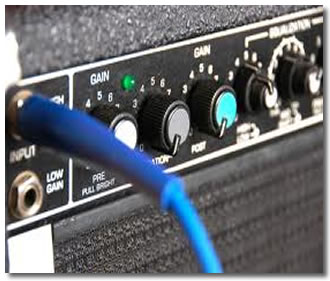
Now, check your front panel control settings. Many of us
are used to leaving the dials set and never changing them,
so it may not occur to you that a dial such as a master
volume or gain has been inadvertently turned off. I fixed
an amp for someone not long ago who returned several days
later screaming at us about how much he paid to have the
amp fixed and now there was no sound at all coming out.
It made my day to plug in a guitar in front of him and
turn up his master volume control from zero. I also had
a situation the other day where I was called onto the sales
floor by a sales person who was demonstrating a tube amp
for a customer. They both were convinced the amp was broken.
I walked over and flipped the standby switch on the front
panel and the amp came roaring on. Modern amps are complex.
There are many features and many ways to go wrong.
|
Move on to the rear panel. Although
the rear panel of an amp may not contain as many
controls as the front panel, there are still places
to go wrong. Many times the standby switch is hidden(
I mean positioned) here and we know where that can
lead. Some amps have their effects loop jacks located
here. If there is a bypass switch associated with
a series effect loop the send and return jacks may
not be connected to each other internally so signal
can flow from the send to the return jacks when no
effects are plugged into the jacks. Therefore if
the loop is switched on and you are not using effects
connected to the loop no sound will come out of the
amp. Mesa Boogie confuses this problem further. On
many of their amps the master volume and solo volume
will only work if the loop is switched on. What does
this have to do with the effects loop? Had a guy
the other day who brought in a Boogie for just that
reason. Turned the loop switch on and all was well
again, but he had suffered through a whole gig without
those functions. Parallel effect loops can cause
a similar problem. Some of the old Marshall Valvestate
amps had a mix control right on the front panel.
Dial it to the right and no sound comes out when
nothing is hooked to the loop. I can't tell you how
many of these came in for " repair" when
these amps were popular.
|
Check for a tube that has come loose or
fallen out. Combo amps are notorious for this because the
tubes hang upside down. And here's a tip for Peavey Classic
30/50 players. The tubes in those amps have their heaters
wired in series. If one tube comes loose they all turn
off. The long skinny EL84 output tubes hang upside down
with a very anemic clamp and tube socket holding it place.
The chances of one of them moving out of place on the way
to your gig are higher than the tube staying in place.
Another cause of no sound coming
out of a tube amp is a blown HT fuse. This fuse is in
the power tube circuit and will likely be on the rear
panel next to the main fuse. It is there to protect the
other components in the output stage especially your
output transformer from damage in the event of a shorted
tube. If the HT fuse is blown everything will look right
about the amp but no sound will come out. I will reiterate
a point here I have made in many of my previous articles.
Just because a tube is lit up does not mean it is working.
A tube has several voltages inside it and the only one
that gives visual evidence of its presence is the heater
voltage. Yet all voltages must be present to produce
sound. The voltage that is connected to the fuse is obviously
not connected to the tube if the fuse is blown. If you
come up against a blown HT fuse there are some steps
you can take that may get you running. First look at
your power tubes. Do you see any cracked glass or a tube
where the top has turned white (near where you spilled
your beer into the amp). Did you notice a specific tube
arcing or the gray metal structure inside the tube glowing
cherry red right before the fuse blew. All of these are
indicators of a blown tube.The safest fix for this is
to replace the fuse and put in the spare set of output
tubes you always have with you. You do carry a spare set
don't you? If you don't have a spare set and it is a four
output tube amp you can pull out the known bad tube and
one other to get the amp working. You won't be as loud
as four tubes are but you will be louder than no sound
at all. Looking at the four tube sockets make sure you
have one tube in one of the two left sockets and one in
one of the right two to keep the push-pull circuit balanced.
Whether this will work or not depends on whether the other
tubes were damaged when the known bad tube was blown. It
will probably be your safest bet to remove both tubes from
the side that the blown tube was on and move one tube from
the other side over as those tubes were less likely to
be damaged. If you don't know which of the four tubes is
bad and don't have a spare set, get out those spare fuses
you always keep with you. This can be tricky. It's possible
that replacing the fuse will bring the amp back to life,but
the question is for how long. Power tubes are notorious
for shorting and then temporarily fixing themselves. You
may get through your gig or it may blow in the next song.
If the fuse blows right away you can try removing one output
tube at a time with a new fuse installed each time to get
the amp to come on without the fuse blowing. You have now
found your bad tube and can proceed as outlined above to
move tubes around to balance the push-pull output stage.
One last thing regarding using your amp with two outputs
instead of four. There are a lot of "gurus" on
the Internet that say this can't be done because it will
overload the remaining tubes and cause them to blow up.
Each tube is its own amplifying device and doesn't know
whether the other tubes are there or not so don't be afraid
to try this.
SOUND IS COMING OUT BUT IT DOESN'T SOUND RIGHT
|
Sometimes we encounter a situation
where the amp is producing sound but it is not right
or behaving intermittently. First analyze what you
hear. Is it not loud enough or distorted when it
shouldn't be etc? With this in mind take a look at
your controls and see if something is set wrong and
causing this condition. If all looks right the next
thing I would try is the first thing my grandfather
( a TV repairman) taught me. Strike the cabinet of
the amp with your fist in multiple places. Does this
cause or eliminate the problem or create crackling?
If it does we are down to two possibilities. First
there is an intermittent connection inside the amp.
There is not much you can do about this and it is
time to send the amp in for servicing. The other
possibility is an intermittent tube. I would gravitate
here to the preamp tubes. The output tubes can cause
this but are more likely to short and blow fuses.
EL84 output tubes are the exception to this. They
are very likely to crackle, hum squeal etc. But The
preamp tubes are the biggest suspect here. You can
try removing any covers over the tubes and flick
your finger repeatedly against each tube one at a
time. If you can get a tube to cause the problem
you are hearing, try replacing it with the spare
preamp tube you always carry with you. If the new
preamp tube does the same thing you may have a dirty
socket. You can try inserting the tube in the socket
multiple times in the hope you will strip off enough
of the corrosion to make a good connection. |
A preamp tube can also fail in a way that is not vibration
sensitive. You can take your spare preamp tube and one
at a time replace the preamp tubes in the amp to see if
you can locate a bad one. Remember also, I find most of
the time that any problem that takes a while to start,
be it crackling, no sound, etc. is likely to be a preamp
tube that fails when it heats to a certain temperature.
Another test method is to divide and conquer. You can
try taking the preamp out or effects send to another power
amp and see if you get sound. Same for another preamp into
the power amp or effects return. You just might work something
out to help get you through a gig.
ATTITUDE
I could go on and on with problems and remedies but I
would like to touch on some things about attitudes and
misconceptions people have that limit them from being able
to solve even a simple problem when it comes up.
First and I hear these repeatedly,
"I just bought this, there can't be anything wrong
with it". For those of you who believe this I invite
you to my shop to see the pile of equipment to be fixed
that has not even been sold to a customer yet. And my other
favorite- "I've had this for fifteen years and there
has never been a problem" I usually don't say anything
to that- but I do give a long blank stare to the customer.
Although if there is any truth to the above in a specific
situation, these are the people who should be checking
their wiring and control settings for problems since they
believe there can't be anything wrong with their equipment.
You may have used your amp 1000 times before, but that
doesn't mean you couldn't of done something wrong this
time or something was changed by accident.
Another attitude I see is the " artist" attitude.
Those that believe their sole purpose in life is to create
and can't be bothered or it is beneath them to understand
anything about their equipment. I certainly respect artistry
but if you are also performing in a professional or academic
situation ignoring how your tools function can make you
look like an amateur and robs you of the ability to create
your art at the time if your equipment doesn't work. Take
the time to learn your equipment. Read the owner manuals,
ask questions to those who are knowledgeable about it.
A better understanding of your tools will help your creativity.
Next month I will be talking about something close to
my heart- How to get the best results when bringing your
equipment to a service center for repair. It will be a
great glimpse inside the customer service insanity I handle
every day