|

Each month we will be checkin what we feel
is an album that definitky may be worth revisiting. Sometimes
it is easy to forget how great some of these releases were. Many of
them went on to have signifigant influence on the music of
today. When going back and checking them out again you will
often find forgotten brilliance and just maybe it will give you
a new spark of inspiration for creating something awesome
on your own. (-: Thanks to
Wikapedia
Hendrix was 15 when he began to learn how to
play guitar. He earned his dues by beginning his music career
on what was known as the "chitlin circuit" (places safe for black
artists to play in during the days of segregation and during
its abolition), playing as a backup artist for various acts (Little
Richard, the Isley Brothers) that toured the eastern and southern
US in the mid-60s. But he was often looking for new artists to
work with due to his show-stealing guitar ability. Still, he
got his break when The Animals' ("House of the Rising Sun," "Don't
Let Me Be Misunderstood") drummer Chas Chandler, who was soon
to go into managing acts, saw him in a New York club and convinced
him to go to England to record. Putting together what would become
the Jimi Hendrix Experience, Are You Experienced? would
hit the record stores in 1967 and make the young guitarist an "overnight
success," which, in the fact that he had virtually never written
a song before The Experience was formed, he was. The band became
a great success in England (where he would be far more successful
during his lifetime), charting three Top 10 songs from the first
album, and then in the US after the 1967 Monterey Pop Festival.
On September 20, the anniversary of Hendrix' death reminds us
of the legendary virtuoso and his music. It also reminds us of
what was lost, the short time he was here to share his gift,
and just how much his music and style has influenced the world.
Electric Ladyland is the third and final
album of new material by the Jimi Hendrix Experience, released
in October 1968 on Reprise Records, catalogue RS 6307. It is
the only Hendrix studio album professionally produced under his
supervision. It topped the Billboard 200 album chart for two
weeks in November 1968.
Released as a double album, Electric Ladyland
is a cross-section of Hendrix's wide range of musical talent.
It includes examples of several genres and styles of music:
the psychedelic "Burning
of the Midnight Lamp", previously a U.K. single in the summer
of 1967; the extended blues jam "Voodoo Chile"; the
New Orleans-style R&B of Earl King's "Come On";
the epic studio production of "1983... (A Merman I Should
Turn to Be)"; the social commentary of "House Burning
Down"; and the Sixties-era Britpop of Noel Redding's "Little
Miss Strange". The album also features an electric reworking
of the Bob Dylan classic "All Along the Watchtower",
which has been well received by critics as well as by Dylan himself,
and also "Voodoo Child (Slight Return)", a staple of
both radio and guitar repertoire.
Recording and production
Following the first installment of recordings
from Olympic Studios in London, including part of "All
Along the Watchtower" and the aforementioned 1967
single, production moved during the spring of 1968 to the
newly opened Record Plant Studios, situated close to Hendrix's
favorite New York clubs.
Recording there was by Jimi's
favorite engineers Eddie Kramer and Gary Kellgren. Despite
a claim by Record Plant engineer Chris Stone that Kellgren
engineered "90%" of Ladyland, the studio records
show that most of the work was done by Kramer, only three
tracks including the one by Redding having Kellgren as
engineer. |
|
During the recording of the album, Hendrix fell
out with producer Bryan "Chas" Chandler and bassist
Noel Redding. Both of them grew tired with the undisciplined
way Hendrix was working in the studio, because he was constantly
inviting his friends and acquaintances in there. Chas Chandler
hated spending so much time in the studio and partly blamed it
on these guests, but Jimi was determined to have his way. Chandler
also complained that Hendrix's insistence on doing multiple takes
of every song, combined with what he saw as Hendrix's drugged
incoherence, led him to sell his share of the management company
to his partner Michael Jeffery. Chandler quit in May 1968, leaving
Hendrix sole producer on the project.
Hendrix' studio perfectionism was legendary – he and Mitchell
recorded well over 50 takes of "Gypsy Eyes" over three
sessions, Hendrix was generally insecure about his voice and
often recorded his vocals hidden behind studio screens. Hendrix
sang all the backing vocals himself on the title track and on "Long
Hot Summer Night". He was said to be very happy with the
vocal results on "Have You Ever Been to Electric Ladyland."
Many of the album tracks show Hendrix's
vision expanding far beyond the scope of the original trio
and saw him collaborating with a range of outside musicians
including Dave Mason, Chris Wood and Steve Winwood from Traffic;
future Band of Gypsys drummer Buddy Miles; Jefferson Airplane
bassist Jack Casady; former Dylan organist Al Kooper; and members
of 'the Serfs': Mike Finnegan on organ, Freddie Smith on saxophone,
and Larry Faucette on congas. Cooperation between Hendrix and
bassist Noel Redding, who was of the same opinion about time
spent in the studio as Chandler, was strained during production.
Hendrix plays bass on many tracks, including the bass solo
on "1983". At times Hendrix
recorded bass tracks simply to make things proceed faster. Redding
plays acoustic guitar and sings lead vocals with Mitchell on
his own track, "Little Miss Strange."
Release and reception
The UK edition reached #6 on its release amid
considerable controversy. A letter Hendrix wrote to Reprise described
exactly what he wanted for the cover art, but it was mostly ignored.
He expressly asked for a color photo by Linda Eastman of the
group sitting with children on a sculpture from Alice in Wonderland
in Central Park, even drawing a picture of it for reference.
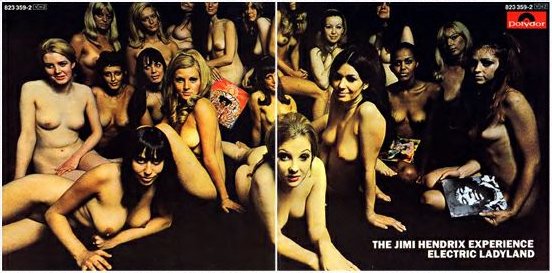
The company instead used a blurred red and yellow photo of his
head, taken by Karl Ferris. Track Records had its own art department,
which produced a cover depicting 19 nude women lounging in front
of a black background taken by photographer David Montgomery,
who also shot the inside cover portrait of Hendrix. Later reissues
for compact disc in 1997 and 2010 feature the Ferris cover worldwide,
and the Hendrix family has indicated that they will no longer
use the nudes cover since Hendrix himself expressed his opinion
against the nudes cover saying that it was rather an opposite
to what he had wanted.
In 2005 Q magazine readers voted Electric Ladyland the 38th
greatest album of all time; in 2003 the TV network VH1 placed
it at number 72. In 2003, Rolling Stone declared it the 54th
greatest album of all time. The album is included in the book
1001 Albums You Must Hear Before You Die. Also, The Source magazine
ranked it #40 on their Critics Top 100 Black Music Albums of
All Time list in 2006.
Hendrix was only 27 when he died in 1970.
He was working on his next album, which was tentatively titled
First Ray of the New Rising Sun, when he died of complications associated
with drug usage. |