| Each
month we will be checkin what we feel is an album that definitky
may be worth revisiting. Sometimes it is easy to forget how
great some of these releases were. Many of them went on to
have signifigant influence on the music of today. When going
back and checking them out again you will often find forgotten
brilliance and just maybe it will give you a new spark of inspiration
for creating something awesome on your own. (-: Thanks
to Wikapedia
The Who have announced they will embark on a
36-date Quadrophenia tour this fall, performing their 1973 rock opera in
its entirety. The band's first North American tour in four years will kick
off on November 1st in Sunrise, Florida.
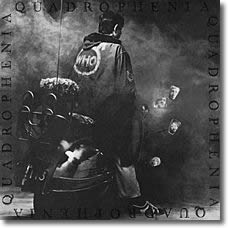
Quadrophenia is the sixth
studio album by English rock band The Who. Released on 19 October 1973
by Track and Polydor in the United Kingdom, and Track and MCA in the
United States, it is a double album, and the group's second rock opera.
Its story involves social, musical and psychological happenings from
an English teenage perspective, set in London and Brighton in 1965.
The name is a variation on the popular usage of the medical
diagnostic term schizophrenia as dissociative identity disorder, to reflect
the four distinct personalities of Jimmy, the opera's protagonist – each
said to represent the personality of one member of The Who.
At the same
time, the title is a play on the term quadraphonic sound, then a recent
invention. Composer Pete Townshend has said: "The whole conception
of Quadrophenia was geared to quadraphonic, but in a creative sort of
way. I mean I wanted themes to sort of emerge from corners. So you start
to get the sense of the fourness being literally speaker for speaker." |
 |
During the album production Pete Townshend
made many field recordings with a portable reel-to-reel recorder. Some of the
location sounds that made it to the record were waves washing on the beach
and a diesel train whistle recorded close to Pete Townshend's house at Goring-on-Thames.
The ending of "The
Dirty Jobs" also includes a musical excerpt from The Thunderer, a march
by John Philip Sousa. Townshend recorded this while listening to a brass band
perform at a park.
Quadrophenia was originally released as a two-LP set with a gatefold jacket
and a thick booklet containing lyrics, a text version of the story, and photographs
illustrating the tale. MCA Records re-released it as a two-CD set in 1985 with
the lyrics and text story line on a thin fold-up sheet but none of the photographs.
The original Polydor CD issue included the complete booklet in miniature, as
did the remastered MCA and Polydor CD reissues of 1996.
 |
Quadrophenia was originally released
in the UK as Track 2406-110/111 on 26 October 1973. However, it appears
that owing to a vinyl shortage caused by the OPEC oil embargo, only a
limited number of copies got to stores before production had to be halted.
Most British Who fans failed to find a copy until after The Who's UK
tour. In the UK, Quadrophenia reached the #2 position, being held out
of the top spot by David Bowie's Pin Ups, which contained cover versions
of The Who songs "I Can't Explain" and "Anyway, Anyhow,
Anywhere".
The 8-track tape version of this album has the distinction
of being one of the few 8-tracks that is arranged exactly like the album,
with no song breaks. |
In the liner notes to the remastered Odds & Sods Townshend revealed that
Quadrophenia evolved from an idea for a self-indulgent autobiography of the
band (which was allegedly to have been titled Rock Is Dead—Long Live
Rock!). Two of the opera's tracks date from 1972 ("Is It In My Head?" and "Love
Reign O'er Me"), a year that also produced The Who's singles "Join
Together", "Relay" and "Long Live Rock" (the last
not actually released until 1974). However, by the time Quadrophenia was released,
the band's role in the story was only symbolic, through Jimmy's four personalities.
Quadrophenia reached #2 on the US Billboard album chart (kept from #1 by then-labelmate
Elton John with his Goodbye Yellow Brick Road album) and was the highest position
of any Who album in the US as they would never hit #1 on the US album charts.
The band viewed the tour in support of the album as disastrous.
Owing to extensive use of synthesisers and sound effects on the record, the
group elected to employ taped backing tracks for live performance, as they
had already done for "Baba
O'Riley" and "Won't Get Fooled Again". Initial performances
were plagued by malfunctioning tapes. Once the tapes started, the band had
to play to them. The band felt constrained in playing to these recordings,
preferring a more free-form attitude.
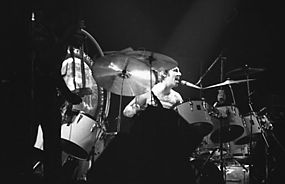
On the first night of the US leg at the Cow Palace in San Francisco,
drummer Keith Moon collapsed onstage. Scot Halpin, an audience member, was
brought on to finish the show.Pete Townshend now looks back on the album with
great pride. "The music
is the best music that I've ever written, I think, and it's the best album
that I will ever write". "We never really ever made a truly
great album again."
In May 2011, English writer Peter Meadows published a novel called To Be Someone
based on characters presented by the album. On 1 June 2011, Townshend stated
in a blog entry on The Who's official website that he had begun working on
a deluxe edition of the album. It was released as a 5-CD box on 15 November
2011.
Townshend noted in 2009 that, rather than Jimmy’s personalities representing
a Who member, he chose the personalities of each member to illustrate each
of Jimmy’s four personalities, or "personality extremes" or
mood swings.
The liner notes illustrate this concept as follows (names added):
- A tough guy, a helpless dancer. ("Helpless Dancer" – Roger
Daltrey)
- A romantic, is it me for a moment? ("Is It Me?" – John
Entwistle)
- A bloody lunatic, I'll even carry your bags. ("Bell Boy" – Keith
Moon)
- A beggar, a hypocrite, love reign o'er me. ("Love Reign O'er
Me" – Pete
Townshend)
In addition to describing a personality/band
member, the four descriptions refer to four musical themes that portray
Jimmy's personalities in the opera: "Helpless Dancer", "Is
It Me?", "Bell Boy", and "Love Reign O'er Me".
The four themes (or "leitmotifs" as described by Townshend)
are mixed together in both the title track (bridging "The Real Me" and "Cut
My Hair"), and the penultimate track, "The Rock" (bridging "Doctor
Jimmy" and "Love, Reign O'er Me").
The two pieces were
the most musically complex pieces that Townshend ever wrote for The Who,
combining all four themes into two six-minute instrumental medleys. The
two pieces have neither a definite beginning nor end, as they begin with
a fade-in from the previous track, starting with the theme of "Bell
Boy" (Moon's theme). |
 |
This is followed by the themes of "Is It Me?" (Entwistle's
theme), "Helpless Dancer" (Daltrey's theme), and "Love, Reign
O'er Me" (Townshend's theme). "Quadrophenia" fades into rain
sound effects after the "Love Reign O'er Me" theme. "The Rock" however
ends with a combination of the four different themes, using the "Bell
Boy" theme as the chord sequence, the "Helpless Dancer" theme
as the melody, the "Is It Me?" theme as a lead (played on guitar
and synthesiser), and the keyboard part to "Love Reign O'er Me" as
a countermelody. The whole song abruptly ends on a downbeat layered with the
sound of thunder and descends into "Love Reign O'er Me" proper.
The four themes also surface on many other songs throughout
the album; the most subtle example being when the "Helpless Dancer" theme appears
on "Bell Boy" (the main song) played on synthesiser as a brief interlude.
Some themes from other songs also make "surprise" reappearances here
and there. These leitmotifs help give the work an impression of a cohesive
unity.
In 1979 the film Quadrophenia was released, with three additional songs written
by Townshend (see Quadrophenia (soundtrack)). The film was an accurate visual
interpretation of Townshend's vision of Jimmy and his surroundings, and included
the casting of a young Sting as the Ace Face. In the film, the music was largely
relegated to the background, and was not performed by the cast as in a rock
opera.
In 1995, the rock group Phish performed Quadrophenia
in its entirety as their second Halloween musical costume at the Rosemont
Horizon, Chicago, Illinois. The recording was later released as a part of
Live Phish Volume 14. The jam band also covered the tracks "Drowned" and "Sea and Sand" on
their live album New Year's Eve 1995 – Live at Madison Square Garden,
and played an extended version of "Drowned" in several of their concerts
since.
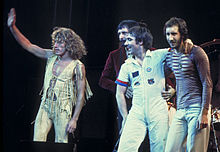
In summer 1996, The Who, with a large backing group featuring,
among others, Zak Starkey on drums (his first appearance as The Who's drummer),
Geoff Whitehorn and Simon Townshend on electric guitar (the former played
lead guitar on almost all of the songs) and keyboardists Jon Carin and John "Rabbit" Bundrick,
performed Quadrophenia in its entirety for the first time in many years in
London's Hyde Park, with guest performers Phil Daniels as the Narrator/Jimmy,
Gary Glitter as The Rocker, Adrian Edmondson as the Ace Face/Bellboy, Stephen
Fry as the hotel manager (screaming, "Bellboy!"), Trevor McDonald
as the newsreader and Pink Floyd's David Gilmour as the bus driver. Gilmour
also played additional lead guitar for that first performance; he sang and
played lead guitar on "The Dirty Jobs", plus performed lead guitar
on "Sea and Sand", "Dr. Jimmy", "The Rock", "Love,
Reign O'er Me", and "5.15" (reprise). A subsequent tour of the
US and UK followed, employing most of the same players but with Billy Idol
replacing Edmondson.
In 2005, a live performance of Quadrophenia from The Who's 1996/1997 tour
was included in a three-disc DVD box set released by Rhino Entertainment, also
featuring a live performance of Tommy from 1989 as well as other hit songs
performed live. Townshend and Daltrey provided special commentary, and an interview
with Billy Idol was also included.
The Who performed Quadrophenia at the Royal Albert Hall on
30 March 2010 as part of the Teenage Cancer Trust series of ten gigs. This
one-off performance of the rock opera featured guest appearances from Eddie
Vedder, lead singer of Pearl Jam; and Kasabian's Tom Meighan. Tom Norris, jazz
musician and violinist with the London Symphony Orchestra, played violin in
the production. |