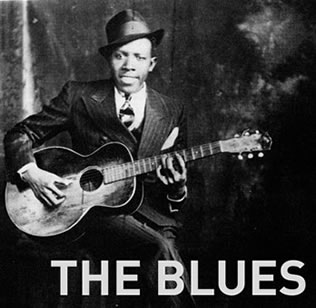
The last
12 months have seen the passing of legendary blues
artists
like Pinetop Perkins, Honeyboy Edwards and Willie “Big
Eyes” Smith.
For those dedicated to "keeping the blues alive",
the death of any old
timer gives pause to the mission. Edwards was the last
living
contemporary of Robert Johnson, the enigmatic guitarist
of the 1930's
whose posthumous popularity in the 1960's enshrined
him as the blues
icon supreme.
But Johnson was not a great popularizer
of the blues in his day. That
role in history belongs to female professionals like
Ma Rainey and
Bessie Smith, whose influence on popular song was
immediate and long
lasting. Robert Johnson was an artifact to be "rediscovered" later
by
white folk music enthusiasts who romanticized the
notion of rustic
bluesmen roaming the Delta practicing hoodoo. Meanwhile
the actual
music in the form of artists like Muddy Waters (with
whom the departed
Pinetop and Big Eyes both played) had moved up river
to Chicago and
electrified itself, enjoying a moment of popularity
and influence in
the rapidly evolving world of black music.
A vision of what the blues
is supposed to be
By the dawn of the 60's, black culture
was already moving forward with
soul music, a secularized gospel sound that reflected
the hopes and
dreams of the Civil Rights movement, and hard rockers
like Muddy and
John Lee Hooker had taken to playing unplugged at
folk festivals,
catering to the white audience's preference for a
non-threatening
almost pastoral fantasy of the blues. |
|
It would be another group of white blues
fans, from England of all
places, who would disabuse their fellow enthusiasts of
what the blues
was all about. "The British Invasion" of the
American pop charts by
bands like The Rolling Stones was achieved through their
earnest
emulation of electric Chicago blues. While this only strengthened
the
resolve of folk purists against "commercial" sounds
original
progenitors like Howling Wolf enjoyed new found popularity
amongst
white audiences, and the clumsy renditions of black blues
by white
artists eventually evolved into everything we know today
as "rock"
music.
While early British blues rockers were
quick, like Elvis before them,
to humbly qualify themselves as pale imitations of the
real thing,
subsequent waves of white blues practitioners and fans
alike would
formalize their own vision of what the blues was supposed
to be,
leading to a schism upon which rests the answer to the
question of
whether the blues lives or dies!
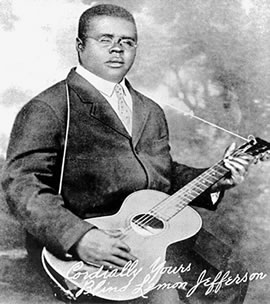
Both sides are mostly white people deciding
how the blues is connected
to black culture. That the blues is black might seem obvious,
but it
really depends on how you frame the issue. You can see
the blues as a
cultural thing, that is to say coming from a culture, or
you can
declare it merely accoustic or sonic, a style of song structure,
vocal
timbre and bent notes that any musician can perform.
Both sides demand authenticity and for
the culturalists, the basic
marker is simple: black skin. Even being the proper color,
an artist
influenced by white blues rock like Robert Cray is considered
less
authentic than a country amateur from Mississippi. The
cultural
purists search high and low for signs of a living
blues
tradition that
conforms to their long-running rural fantasies, but often
they find
just tainted hybrids and old men dying.
The more inclusive
view that white people can play the blues is much
more popular, for obvious reasons. As a musical genre and
as an
industry, "the blues" is a thriving self-contained
universe. Here
culture is used as a hook, branding the blues not just
as an
entertainment commodity but as a dying art to be preserved
by
non-profit societies and foundation grants. To keep the
blues alive
becomes a vast undertaking of marketing and volunteerism,
an activity
unto itself with no cultural links other than to a faded
history
rendered quaint by the white imagination.
 |
Here authenticity is
determined in ways peculiar to a scene that's been
recycling the same set of cues for thirty years.
At the International Blues Challenge, an annual event
staged in Memphis that pits amateur blues bands from
around the world against each other for the title
of World's Best Blues Band, the performances cohere
to a tradition of males dressed in period costume
playing antique instruments without irony, be it
long-haired tattooed blues rockers from the 70's
to shark-skin suited hipsters from the 50's. It's
living dead blues, not just preserved but pickled!
The contestants, the judges and the audience are
mostly white. Not only might the winners not be black,
they might not even be American!
While the majority of blues consumers
believe the blues belongs to everyone, the authenticity
of blackness will always have its value. While the
cultural view sees blues as something that can only
be transmitted within a community, most see the original
blues generation as mentors capable of training white
successors to carry the blues torch forward. With
the passing of Honeyboy Edwards and eventually the
rest of his generation, such possibilities will be
gone. Eventually the old white guys who knew the
old black guys will be gone too. Will white people
be able to keep the dead blues alive?
What some black folks call
the blues
One may wonder what black people
think of all this. ("We can't let happen to
hip hop what happened to the blues!" warned
a poster in a Vibe Magazine forum discussing Eminem's
acceptability as a legit rap artist.) While African
American culture is not known for nostalgia and has
gone from blues to gospel to jazz to soul to funk
to disco to hip hop, basically revolutionizing world
music for the last hundred years, some tastes have
looked back
fondly to a bluesy place. There is actually
a music that some black folks listen to that they
call the blues! |
It can be seen evolving from artists
like Little Milton, whose
sophisticated soulful blues was labeled "urban blues" by
white taste
makers to differentiate it from the more rustic sounds
they preferred. "Urban" has since become de facto marketing speak
for "black", and
indeed urban blues essentially became the black blues,
as in the blues
that black people liked, but it is as much country as it
is city,
epitomized by Z.Z. Hill's anthem "Down Home Blues".
With Malaco Records spearheading this black
southern sound, it became
known externally as "southern soul" (if only
to placate white
enthusiasts insisting "That's not the blues!")
but on the scene it's
always known as the blues. Over the decades it's picked
up all kinds
of grooves left over from black music's evolution, always
swinging,
often cheesy, making with the sweet come on's or the hip
pocket
wisdom. This
is what black
people in Mississippi call the blues. There's
lots of artists
there, even Muddy Waters. But no white people.
How then will the blues be kept alive?
Luckily for us,the blues
had a baby and they called it rock and roll! If only we could call
our music what it is and let the blues live or die with
dignity. |
Bonefish Johnny is an armchair musicologist
and roots rocker located
in south Florida. Johnny can be reached at his
website bonefishjohnny.com
The views, opinions expressed by the
authors and those providing comments are theirs alone,
and do not necessarily reflect the views, opinions, positions
or strategies of Metro Music Mayhem. We make no representations
as to accuracy, completeness, currentness, suitability,
or validity of any information contained within and will
not be liable for any errors, omissions, or delays in this
information or any losses, injuries, or damages arising
from its use. |