|
Hello again, and welcome to the seventh
installment of Luthier’s Corner. For this issue, I’d
like to discuss the pros and cons of the 3 main types
of neck mounting in electric guitars and basses: bolt
on, set neck, and neck through body, and a bit of their
histories.
When you think bolt on, you think Fender Stratocaster,
set neck: you think Gibson Les Paul, and neck through:
you think Rickenbacker. These are, of course, the companies
and models that not only exemplify their respective designs,
but also are where the 3 different neck mounting approaches
originated, in terms of mass production.
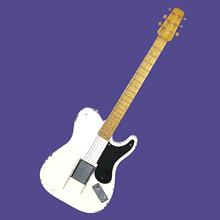
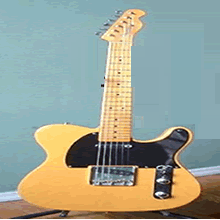
To understand the bolt on neck, we
need to go back to 1948, and the little radio repair
shop of Leo Fender. It was then that Leo came up with
the prototype for what would become the prototypical
rock, country, pop, guitar-the Fender Broadcaster, which
would later be rechristened the Telecaster. It was the
first bolt on neck guitar and is still, pretty much,
the industry standard by which all others are judged.
Whether you play a Tele, Strat, Kramer, or various other “superstrat” type guitars,
it very likely has a bolt on neck design, which is usually
4 wood screws that fasten the neck to the body. The advantage
to this design is that, should the neck get damaged or
broken, it can easily be removed and replaced with very
little work. The disadvantage to the majority of bolt on
guitars is that the neck joint is fairly bulky which can
inhibit easy upper fret access, unless you have a newer
type of bolt on guitar, like those made by ESP, Schecter,
etc, that is either sculpted or shaped in a tapered manner
to make upper fret access easier. Another aspect of a bolt
design is that the tightness of the cavity, as well as
how tightly the neck is bolted on the body, can have an
effect on the sustain and resonance of the guitar. Most
70’s Fender guitars were notorious for lacking sustain
and resonance due to having neck joints that were not very
snug at all and the necks could actually move around in
the cavity.
|
|
|
|
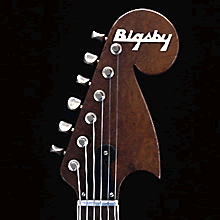
Bigsby Headstock |
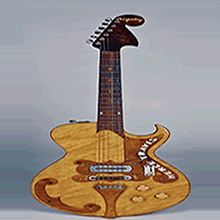
Bigsby
Merl Travis |
Broadcaster
Prototype |
Fender
Telecaster |
 |
 |
 |
 |
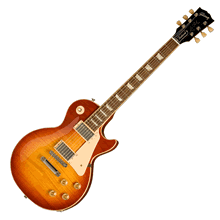
Gibson
Les Paul |
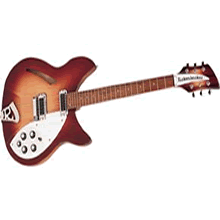
Rickenbacker
330 |
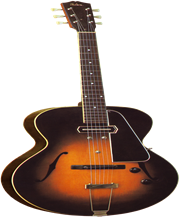
Gibson ES-150 |
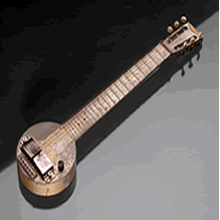
Rickenbacker Frying Pan |
Next we have the set neck design
that you have seen on the Gibson Les Paul, SG, Flying
V, etc, as well as other , Gretsch, Guild, and many others.
This design has been around since the first acoustic
guitar was ever built, hundreds of years ago, and is
the most common type of neck joint out there. Whether
you have an acoustic guitar, classical, archtop, or solibody
SG, chances are, it’s a set
neck. But the first real electric guitar to use this design
was the Gibson ES-150, commonly known as the Charlie Christian
and debuted in 1936. The first solidbody, set neck guitar,
was the Gibson Les Paul Goldtop, which debuted in 1952.
What’s nice about this design is that it gives the
guitar a certain look of class and sophistication, as well
as being sleek. The advantage is that a set neck design,
with a good sized tenon that’s tight fitting, produces
excellent sustain and resonance. Just listen to any Gibson
Les Paul plugged into a Marshall stack to verify that statement!
Or course, should the neck get damaged or broken, replacing
it is more involved, usually requiring steaming the neck
off, to loosen the glue and remove the neck, which is recommended
to be done by a professional luthier. The other disadvantage
is that most set neck guitars tend to have a somewhat bulky
neck joint, almost as bulky as a traditional bolt on, save
for the slim set neck guitars like the Gibson SG. Of course,
many newer set neck guitars have revised the neck set design,
which has virtually done away with the bulky neck heel
altogether, like the Gibson Neal Schon Les Paul.
Finally we come to the neck through
body design, the first of which debuted in 1931, by Rickenbacker,
was called the A-22, and was known as the Frying Pan
because of its obvious shape. It was actually the first
lap steel guitar built and it wasn’t until 15 years later, in 1946, when
the first solidbody electric guitar, as we know of them
today, was actually built by a motorcycle repairman known
as Paul Bigsby, who is more well known for the vibrato
tailpiece that bears his name than for the one piece maple,
solid body electric guitar that he built for Merle Travis.
What’s interesting about that first Bigsby guitar
is that you can clearly see that it really did inspire
at least 2 other companies with certain designs. The body
is shaped very much like a Gibson Les Paul. The headstock
looks like the Strat headstock of the 70’s, big and
round. Bigsby hand made every guitar that he built, and
so, of course, he could not compete with the mass production
approach of the day of companies like Gibson, Fender, Rickenbacker,
etc. Many higher end companies, such as Carvin, ESP, Rickenbacker,
and others, use this design. The main advantage of this
design is that there is virtually no bulky neck heel in
the way of upper fret access. The other advantage is that,
since you have one long piece of wood from head to back,
tonal consistency is usually superb as the resonance is
consistent from one end to the other. The main disadvantage
to this design is that, should the neck get damaged or
broken, you could not replace the neck, and it would have
to be repaired or rebuilt. Any experienced luthier, however,
would be able to accomplish this task, and I have had numerous
neck through guitars, and set necks for that matter, come
through my shop that needed a break repaired or rebuilt.
So don’t worry about the risks, if you own such a
guitar.
Well, now that you know, in a nutshell,
about the 3 different neck mount designs, you’re probably wondering which
would fit your style more. Well, that, my friend, is really
a matter of taste and preference. There are those that
swear there is no better guitar in the world than a bolt
on Strat or Tele. There are those that would thumb wrestle
you into submission if you dared scoff at the superiority
of their set neck Gibson Les Paul. And there are those
that would only ever own a neck through body Carvin DC400.
Who’s right? Who’s wrong? Exactly. That’s
what makes the electric guitar so much fun, yet frustrating
at the same time. There are so many infinite choices and
possibilities that, if you’re like me, you never
get enough, and you probably own at least one of each type,
if nothing else than to satisfy your curiosity.
OK so, I hope you enjoyed this month’s
Corner and feel a bit more informed. If I have answered
any questions or curiosities that you had prior to reading
this, then I did my job.
Once again, thanks for reading my column and remember no
task worth accomplishing is ever achieved if not pursued
with fierce dedication. Believe in yourself, and make happen
that glorious noise called music! Until next time, remember,
there is nothing you can't do if you set your mind to it!
Cheers!!
|