This
month is part four in our series
on tube guitar amps. I want to continue
with a discussion on an amp's power supply.
I invite you to the Metro Music Mayhem
Archives to view earlier articles in
this series.
What is the power supply? I always find
it easier when analyzing to break the guitar
amp up into separate subsections. Even
though they are all interrelated in the
production of the final sound, it makes
it easier to understand by looking at the
different sections. I divide it up into
preamp, power amp, effects, switching control
and the power supply.
The power supply does just what its name
says. It takes the 120 volt AC that comes
out of your wall outlet and converts
it to several AC and DC voltages that
power the various functions in the amp.
Although there are many new technological
permutations of the power supply we are
going to discuss only the classic linear
style power supply used in most tube
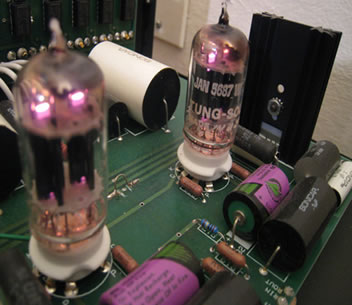
amps. This power supply consists of a
transformer, rectifier and filter caps.
Some of the classic amps include
a device called a choke and I am also
inclined to include the output transformer
as part of the tube amp power supply
for reasons I will get to.
Here is an explanation of how the power
supply operates:
The
120 volt AC power from the
wall is input to the primary of
the power transformer. On its output
(the secondary) we derive the raw
AC voltages we need throughout
the amp. Typically you will find
the 120 volts AC stepped up to
300-500 volts to power the tube
plates, stepped down to 5-6 volts
to power the tube heaters and other
voltages in between to create bias
and control voltages.
Next those voltages that need to be converted from AC to DC are run through a
rectifier circuit. The rectifier can be a tube or a silicon diode, an important
point we will come back to. The rectifiers convert the AC power coming from the
transformer to DC by letting only part of the AC pass. Alternating Current
means that each cycle of power has both a positive and negative component. It
is a safer and more efficient way for the power company to transmit power to
you as opposed to Direct Current. but an amplifier needs DC to operate so we
must convert (rectify) it. The rectifiers only do part of the job of creating
DC. They create DC but it is in pulsed form. As the rectifiers turn on and off
with the alternating power there are gaps between each cycle. The filter
caps are fed this pulsed power. They charge up when the rectifier conducts power
to them and release the power during the time the rectifiers are off filling
in the gap and creating smooth DC power. This occurs 60 times a second and is
why if the filter caps are not doing there job properly the 60 HZ A/C can mix
into the audio path and modulate the guitar signal with the 60 HZ making it sound
like there is a ghost note between Bb and B playing along with every note that
is played |
|
The design of the supply has many variables
that have an influence on the sound of
the amp. It's ability to deliver power
under heavy load determines how loud the
amp can play regardless of the tubes installed.
We all think that four output tubes equals
100 watts and two tubes 50, but that is
only if the design of the power supply
can meet the demands of the tubes to create
that power.The filter caps since they store
energy have an influence over bass response
and if lacking in capacitance through age
or design under heavy load will affect
the low frequency response and as we said
above possibly cause ghost notes to appear.The
output transformer also plays a part in
the power supply. The high voltage that
the tubes use to create audio is directly
input into the output transformer on its
way to the tubes. An output transformer
that can't handle the power given to it
from the power supply will not let the
amp achieve the power level it is capable
of. So it can be said that the set comprised
of the power and output transformer are
crucial in determining what the tubes can
do and become part of the tone of the amp
by virtue of the fact that if they can
pass the needed power the amp can play
loud and clean at least up to what the
tubes can do or if underpowered will cause
the amp to sag even before the tubes do.
I mentioned before that you will see a
filter choke in some amps and there is
much mojo surrounding this part. In the
early days it was hard to get the filter
caps small enough in size at a high enough
voltage and capacitance to create clean
DC power. A choke can be used instead to
smooth out the DC coming from the rectifiers
in lieu of more capacitance. Due to modern
manufacturing methods giving us less expensive
caps in smaller packages the choke has
been replaced by a resistor, falling out
of favor because of its expense and propensity
to create hum. How much influence does
a choke really have in adding to amp's
tone? It is really dependent upon the circuit
it is used in so there is no real answer
for this.
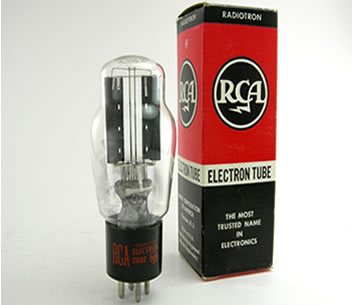
Now let's discuss the rectifier.
In
the early days we had one choice
for the rectifier- a tube. A tube
rectifier is an inefficient device
dropping typically 40-60 volts from
its input to output. Similar to what
we discussed last month with cathode
biasing, this voltage drop increases
under load causing the amp to sag
and compress. As time went on the
solid state diode was developed.
it is way more efficient and drops
less than a volt from input to output
even under load conditions. So just
like when we compared cathode biasing
to fixed biasing we have two different
possibilities, sag with the tube
or louder and cleaner and more bass
with the solid state
rectifier. Due to the economics of manufacturing
and demand for higher power outputs the
tube rectifier is not used much anymore
except in reproductions of vintage amps
or boutique amps looking for a vintage
vibe.
|
There is one
exception to this - The Mesa Boogie
Dual Rectifier amps. As we discussed
in earlier articles when you are
playing an amp and deriving your
distortion from the preamp adding additional
compression from the power amp
or power supply just serves
to muddy things up. The Dual Rectifier
has one of the highest gain preamps
on the market. The amp also contains
two or three tube rectifiers. You
don't have to use the tube rectifiers,
there is a switch to select silicon
diode rectifiers and bypass the
tubes. The problem I see happen
is most players are not aware of
the mud they are adding to their
tone especially at high volumes
when using the tube rectifiers.
They bought an amp that is called
a Dual Rectifier so they think
the tube rectifiers are something
they should be using.
As with all
the other marketing hype bells
and whistles Boogie puts on their
amps the average player doesn't
understand how to use it. I have
been servicing Rectifier amps since
the mid nineties and advise every
heavy style player to switch to
the silicon diodes giving him more
headroom, tighter bass response
and less sag. Invariably I get
a phone call back the next week
to the effect of "Dude, this
amp never sounded this good" You
could say that the Rectifier amps
can be considered extra versatile
inasmuch as you have the ability
to turn the preamp gain down and
use the rectifier tubes to cause
sag to play blues giving an extra
versatility to the amp, but not
once have I met someone who realized
they could do this and who wants
a 100 watt blues amp anyway. There
are certainly better choices. I
view the whole Dual Rectifier thing
as marketing hype. |
Another component in the power supply
subject to much hype are the filter
caps. An electrolytic filter cap
is designed for a life of 10-15 years.
Obviously we have plenty of amps
in service that are 40-50 years old.
I would venture a guess that most
of these have had new caps installed
by now although I still sometimes
get them in for repair with the original
caps.This brings up the question
of changing the tone of the amp by
replacing them. I can assure you
that if you have a sixties or seventies
amp with the original filters it
does not sound as good as it did
in the seventies. If you are a collector
you can leave them alone for aesthetic
sake, but if you are gigging I would
change them out to improve bass response,
reduce ghost noting and to prevent
them from going up in smoke during
a gig and taking out your irreplaceable
vintage output transformer. And by
the way, the fact that you left the
amp in the closet for twenty years
doesn't help. Caps need a certain
amount of voltage on them or they
lose what is called their form. Taking
the unused amp out of the closet and
plugging it in will result in almost
certain destruction. Additionally
in many of the older amps especially
the lower priced models the manufacturers
for the sake of economy used multi
section can caps. These cans contained
two to sometimes five filter caps
in one package and were cheaper to
implement than individual caps. This
was a poor design element, because
even when the caps were new they
were prone to creating ground loops
which means hum. It is always better
to take these multi section cans
out and replace them with individual
caps. Lastly, there is also much
hype over boutique and audiophile(audiofool)
brands of caps. Is there a difference
and is it worth the higher price?
In my experience I don't think so.
Next month we are going to delve into
common failure modes of a tube amp
and their remedies.
Feel free to send me your questions
and suggestions. See you next month.