|

By
Chuck Kirkpatrick
I'm sure for many of us old-timers,
it was a rude awakening; finding out that many of our favorite
songs were recorded not by
the group members themselves, but by a group of faceless, relatively
unknown musicians who just happened to have played on hundreds
of other groups' recordings as well. The same drummers,
the same bass players, same guitar and keyboard players were
playing the instruments on everything we all thought the group
members were. And it is for just this reason that the studio
players were never credited on the records; the record companies
and the group members didn't want people to know.
In the late 90's, I became good friends with
bassist Carol Kaye, the most recorded studio musician in history. Most
of you are familiar with Ms. Kaye's credentials and there is
a ton of information available on the 'net for those of you interested.
After our initial discovery of the existence of studio musicians playing on all
our favorite Beach Boys, Association, 5th Dimension, Mamas & Papas, Grass
Roots and dozens of other albums produced in Los Angeles in the mid-to-late 60's,
my brother and I figured that it was a bunch of hip, young rock and roll guys
who were doing all these sessions. Carol burst that bubble when she told
me and the rest of her fans that that group of studio players were all jazz cats
and pretty much bored by the stuff they did on all those pop/rock hits. They
did it simply to make the money and to be able to still play their low-paying
jazz gigs at night.
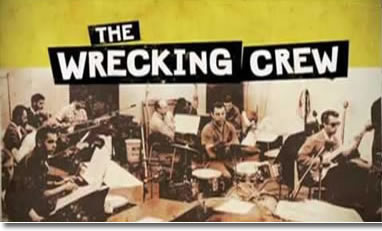
Wrecking Crew
The "Wrecking
Crew" has become the name given to that elite bunch of
L.A. studio players. And there is a very good reason
why they were used on nearly every pop record made. These
people could walk into the studio, sit down and play a
chart through perfectly on the first take. In an
era when so many records were being made - and with studio
rates at a premium - things had to move quickly and efficiently.
A
lot of the songs being recorded at that time were from
professional writers and hand-picked by the producers and
A&R men for the groups being recorded. There
wasn't the time for the groups to learn and rehearse all
the material needed for an album, aside from the fact that
the level of musicianship in most groups was nowhere near
that of the session players. |
|
As a recording engineer, I was witness to many countless hours
of bands struggling with making their albums. Many of these
musicians were very talented and great live players. But
in the studio, some them just fell apart. Perhaps it
is the "under-the-microscope" syndrome; the fact that every tiny
nuance of what you sing or play to tape or disc is going to be
permanent and forever. And when that red light comes on,
many of them 'freeze'. There are other factors. Adjusting
to what's necessary to make something sound good in the studio
might be difficult for the guitarist who is used to playing on
stage through a Marshall double stack, and who now has to settle
for using one cabinet behind a baffle. Same for the bass
player who is used to having his pants flapped on stage by 2000
watts and eight 15" speakers. You simply can't record properly
with that kind of rig. And then there is the time-keeping. Tempo
is probably the one thing that more bands and musicians struggle
with than anything else. On stage, one is given much artistic
leeway and freedom to speed up or slow down to fit the mood. And
the visual stimulation alone makes this tempo shift virtually
unnoticeable by the attending audience. But on a recording,
it's a different story. The listener will be much more
attuned to the tempo and feel and much more subconsciously aware
of any shift thereof. Many producers insist on the use
of click tracks to maintain consistent tempo throughout. Playing
with a click can be very unsettling to all but the most seasoned
studio players.
I was an engineer on a session by a very famous New York band
that had many chart hits. Their drummer was especially
famous for his on-stage prowess and dazzling chops. But
in the studio, I found him to be quite 'stiff'. Springsteen's
drummer Max Weinberg has always been noted for his chops and
endurance, but I found his playing on Springsteen's earlier albums
to be somewhat 'uneven' and a bit busy. Not to say that
Bruce should have brought in a studio guy - that wouldn't have
worked for the chemistry of the band. This was just an
observation of mine at the time.
I wanted to be a studio guitarist in the worst way, but my lack
of reading skills cost me a bunch of sessions with a well-known
local producer in the mid 80's. He was getting alot of
gigs doing the arranging and producing for unknown acts with
limited budgets, and every minute it took me to learn the tune
by ear instead of just reading the chart chewed up studio time
and profits, not to mention test the patience of the other players
who could sight-read the chart on the first take.
With the advent of technology, the disappearing of so many studios,
and so many self-contained artists/groups who write their own
stuff and play on a much higher level, the era of the studio
musician is pretty much gone. But I still marvel at the
tightness, the execution, and most of all the magic of the sound
of a track being recorded live with 10 or 12 musicians in the
room all playing together.
Chuck Kirkpatrick
has worked on numerous million selling and legendary
recordings. While working as a house engineer at the
now legendary Criteria Studios in Florida Chuck's
impressive ‘60s and early ‘70s, historic engineering
feats included a number of well-known
rock artists. Chuck
currently performs with the group "Rock
And Roll Circus" and can be reached at ckirkp1021@aol.com.
|
|