|
Tubes
In past articles we talked much about how tubes work, now
let's talk about what happens when they don't. If you
are not clear or need a refresher on how tubes operate
please refer to my past articles on tubes that may be
found in the Metro Music Mayhem archives.
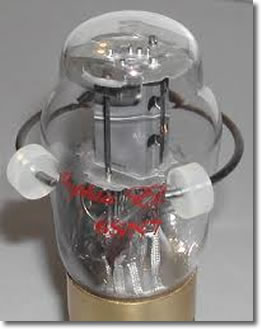
A tube is a relatively fragile device. Its outer structure
is made of a glass envelope containing a vacuum much like
a light bulb. It can have five to six different voltages
connected to it, some of which are several hundred volts
high. It's internal structure consists of metal posts with
extremely fine wires wound around them creating several
concentrically arranged grids. The alignment of the grid
wires is critical so that electrons going from the cathode
to the plate can pass between the grid wires without hitting
them. When you factor in temperature changes as the tube
heats and cools(thermal cycling), vibration, today's marginal
at best manufacturing methods and shipping distances of
thousands of miles,it makes you wonder how we have tubes
that work at all.
Let's look at some specific tube failure modes.
Glass Fracture
If you see a tube and at the top it looks like it is coated
with a white powder this tube has broken its glass envelope,
lost its vacuum and is now no longer a working tube. Possible
causes of this may be, poor manufacturing quality, vibration
during transportation, impact to the tubes directly, cold
liquid spill onto a hot tube (beer!!) or taking the amp
out into cold weather before the tubes cool down to room
temperature.
Microphonics/ Hum/ Crackling/ Noise
If you are experiencing
ringing or squealing sounds, something has come loose
inside the tubes internal construction and is resonating
and adding to the audio. Every tube has a certain amount
of microphonics and most tube vendors do their best
to test and weed out the bad ones. But due to poor
manufacturing, vibration and thermal cycling microphonics
can creep back in. According to its position in the
amplifier's signal chain, the same preamp tube may
be more or less microphonic as different preamp stages
may have more gain than others making a tube perform
worse in the higher gain positions. Output tubes have
very little gain so they won't sound as loud microphonically
as a preamp tube can, but if an output tube is at all
microphonic it is probably only a little bit away from
failing so it should be changed. EL84 output tubes
are the exceptions to this. I think it is a wonderful
sounding tube but it is very prone to becoming loudly
microphonic or going into oscillation.
A good way to test for microphonics
is to flick your finger against the glass of the tube.
This works especially well for the output tubes because
they are generally free of microphonics, so if you can
cause it to ring or crackle at all it is probably bad.
The preamp tubes can fool you. As I said before, some locations
in the preamp are more microphonic than others.
Another failure mode of tubes is excessive hum and or the
output of crackling sounds or constant noise. Again. a
good test for this is flicking your finger against the
tube but this may not always give results like it does
when testing for microphonics as the problem inside the
tube may not be vibration sensitive. I find the Sovtek
brand of preamp tubes to be extremely susceptible to this
type of problem. Remember also this type of problem is
possibly dependent on the temperature of the tube and the
tube may have to reach a certain temperature for it to
become problematic. |
|
My advice is if there is a tube you suspect is bad, leave
all the amp settings the same, turn the amp off and substitute
in a brand new tube.Turn the amp back on and see if you
notice an improvement in performance. If so install the
new tube and discard the old one. I have a fantasy of saving
up some bad tubes and doing a complete retube of an amp
for one of my "special customers". But I digress.
Intermittent Output Tube Shorts
This is a failure that most customers don't want to believe.
Many amps have a fuse on the back panel dedicated to the
high voltage that feeds the tubes. It is generally a 1
amp fuse for 100 watt amps and 1/2 amp for 50 watters.
This fuse is directly in line with the high voltage to
the output tubes and is there to protect the expensive
output transformer, tube sockets and other related components
should there be a condition where too much current is pulled
through the tube. This can happen from loss of bias or
internal damage to the tube from vibration or poor manufacturing.
It also can occur when little pieces of the tube's cathode
coating (chemical that is painted on to promote electron
emission) flake off and get caught in the grids causing
a short. This will usually disappear after the tube cools
off and replacing the fuse will bring the amp back to life.
My advice is always at that point to replace the output
tubes because this is going to reoccur( most likely in
the middle of your big solo) and also because the tubes
and circuitry have been overheated and may not be operating
as well as they should. Of course most customers think
you are just trying to sell them tubes. Happened just the
other day. That's OK with me, I just put a fuse in because
they will be back when it blows again. Only took one day
for that customer to call back.
Tube Sockets
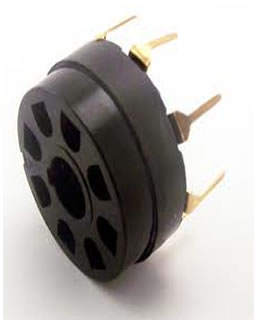
Tube sockets are the components that the tubes plug into
to connect them electrically with the amplifier's circuitry.
The idea behind using a socket was to make the tube easily
removable for testing and replacement purposes. In the
days of tube televisions it facilitated letting the TV
owner take the tubes down to the local drug store and check
them on a tube tester, replace tubes that tested bad and
be back home in time for I Love Lucy.
Tube sockets have their own failure modes that are similar
in symptoms to failures inside the tubes themselves, making
it hard to distinguish where the failure is located.
 |
Preamp tube sockets generally become
oxidized on the contacts that grab the tube pins.
This can cause intermittent signal conditions or
crackling noises when the tube is subjected to vibration.
This is especially prevalent in the higher gain preamp
positions in the amplifier. This is usually easily
cured with a treatment of Deoxit or similar cleaner
unless the socket has completely lost its mechanical
tension.
Output tube sockets have contacts that are larger
than preamp tube sockets as they must receive the
larger diameter pins used on an output tube. They
have a tendency to lose their tension and not grab
the tube pins tightly. Here we have a different set
of failures than with preamp tube sockets. There
is not much gain in the output tubes so they won't
crackle loudly as the preamps do, but they will cause
an intermittent signal condition. If you have an
amp with two to four output tubes and one or more
are going on and off intermittently you are going
to hear radical changes in your volume and tone.
More importantly with an output tube is the pin that
contains the bias voltage. Bias controls how much
current flows through the tube. If it is removed
as in a failure of its socket pin, the tube will
draw as much current as is available causing it to
heat up and fail. You experience several things when
this happens. You will hear a loss of volume accompanied
by a large low frequency hum.If you look at the output
tube it will likely be glowing red on the large metal
plate structure, (not the orange glow the tube normally
has). If you experience this, shut the amp off immediately.
The sockets can be retensioned. Do not attempt this
yourself. There are lethal voltages present at that
socket and sticking something in there CAN kill you.
Let a qualified tech do this for you. Bear in mind
also that loss of bias can occur from an internal
short in the tube itself. And when an output tube
drags down the bias voltage the other tubes that
are not shorted experience a loss of their bias voltage
and can overheat and be damaged or fail. |
A classic example of tube socket problems can be found
in the Fender Hot Rod and Blues Deluxe series amps. Here
we have several factors that combine for bad results. The
tubes are mounted upside down inside the speaker cabinet
and directly in line with the vibrational field of the
speaker. The tube sockets are soldered to a printed circuit
board. As the tubes are vibrated from transportation or
playing they cause the tube socket pins to break their
solder points where they are connected to the circuit board.
This creates all of the problems we mentioned above including
the destruction of the output tubes due to loss of bias.
It is standard practice for me to resolder all sockets
in that style amp whenever one comes in for repair for
any reason.
Sometimes there are conditions that cause arcing across
the output tube sockets. This can come from a variety of
reasons, but the most classic is operating a tube amp without
a speaker load connected. The socket pins by design are
set far enough apart from each other so there is enough
distance between the pins for the 450 volt plate voltage
to not arc to another pin. When the amp is operated with
no speaker it causes flyback voltage spikes from the output
transformer to go back into the circuitry. Due to magnetic
coupling in the output transformer, these spikes can approach
two thousand volts. The next tube socket pin over from
the high voltage pin is the filament voltage pin. This
pin compared to the high voltage pin sits very close to
ground potential (heater filament winding center tap is
grounded and there is not much resistance to the filament
winding). The two thousand or so volts seeking the lowest
resistance path to ground now easily jumps from pin to
pin potentially causing much damage throughout the amp.
On the tube sockets, It can carbonize a track in a phenolic
tube socket and leave it with a permanent short. Even a
ceramic tube socket can be left with a carbon deposit that
is conductive and resistant to cleaning. I usually opt
to replace the socket.
The last failure related to the sockets has to do with
the part of the tube that is located between the pins called
the key way. This "key" has a flange section
on it that will insure the tube is inserted into the socket
properly so its pins mate with the correct contacts on
the sockets. Many times in a combo amp ( the absolute worst
environment for tubes) if a tube falls out from vibration,
a musician unaware the tube must be correctly aligned in
the socket will brute force it into the socket incorrectly.
According to how it is inserted the incorrect mating of
the pins can cause damage to the amp's internal circuitry.
DC Leakage
Here is a failure that can be mistaken for a dirty guitar
volume pot. If the first preamp tube goes bad it can leak
a small DC voltage onto the amplifiers input jack and out
through the cable into the guitar. This is a very small
voltage, usually less than a volt and is not a shock hazard.
What it will do is cause the guitar volume pot to make
noise when it is turned. It sounds similar to a dirty pot,
but cleaning or replacing the pot will do nothing. Simply
replacing the preamp tube will solve the problem.
Rectifier Tubes
As we discussed in earlier articles, rectifier tubes are
part of the power supply. They take the AC voltage from
the power transformer and convert it to DC. Oftentimes
they will fail in a dramatic way and you will see arcing
inside the tube, other times it will just stop working
even though it is still lit up. If the rectifier tube is
not doing its job, there is no high voltage being provided
to the tubes and there can be no sound coming out of the
speaker .Rectifier tubes being large in size and having
only four pins are extremely susceptible to socket problems.
Four pins compared to eight or nine can come loose much
easier especially if the tube is hanging upside down.
Next month, I will move on to some general questions I
am often asked about tubes and also provide a checklist
of what to try if the amp is not working. Please feel free
to leave any questions or comments you may have.
|