|

By
Chuck Kirkpatrick
I'd like to quote from an article I read
years ago about songwriters and recording. "How many people walk down the street humming
a snare drum sound?" That made me laugh for days. Then
I thought of the countless hours my fellow engineers and I spent
screwing with mic selection, placements, head dampening....all
for the sake of getting a great drum sound, with little or no
thought on what we were really supposed to be doing; recording
MUSIC...recording SONGS!
To this day, I steadfastly
maintain that the worst feature ever invented for a recording
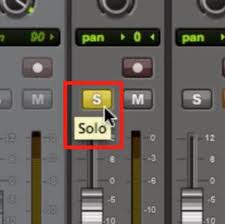
console was the SOLO button. Using this button was akin
to using a magnifying glass to paint a picture with your
eyeballs a half inch from the canvas. People look at pictures,
not at brush strokes. A 'drum sound' is the sum total of
all the mics used, their placement, their balance, and
most importantly, the space occupied by the drums and the
mics during the recording.
At first, we engineers thought that using
more microphones - one for each element of the drum kit
- would give us more control over the sound. Indeed it
did. What we forgot was that drum kits are heard by most
people as a WHOLE, at a nominal distance from and in a
defined acoustical environment - which probably has more
to do with the overall sound of the drums than any of the
kit's individual elements themselves. And yet we drove
ourselves crazy, soloing up every mic placed just inches
from each element of the kit, just to hear all the ringing,
buzzing weirdness that had always been there anyway and
an integral part of the overall drum sound itself. Out
came the gaffer's tape, the blankets, the wallets, what-have-you....in
an attempt to make all that stuff go away. |
|
I will never forget a day in the early
1970's when I walked into a well-known Los Angeles recording
studio and saw the studio drum kit. To my amazement, every
square inch of every tom tom top head was completely covered
with gaffer's tape, as if the heads were made of tape alone. "Keeps 'em from ringing....".
Such was the era of disco and drum sounds in general. It got
the point where snare drums were being made to sound like deadened
floor toms...or large boxes of sand being hit with brooms.
Thank God we got through that, and things began to go the other
way with more ambience becoming the norm. Still, the multiple
mic technique prevailed because we had to have that control.
But did we ever stop to wonder what it must have been like for
the drummer who spent countless hours behind his kit and was
used to hearing it from where he sat and then hearing it back
on tape the way we thought everyone else should hear it? Must
have have been a bit strange, but God bless 'em, they trusted
us engineers.
|
Volumes have
been written by hundreds of engineers about their drum
recording techniques and few two are alike. There does
seem to be a common thread where general placement is concerned;
two overheads, kick, snare, hat, toms, etc. There are those
who use two, even three mics on a single element (top and
bottom of snare and toms). Add to all that, the room mics.
Things begin to differ where mic choice is made; condenser,
dynamic, or ribbon...large or small capsule. Then comes
choice of mic preamp; tube or solid state. Add to all this
the effects; EQ and compression. The choices are endless,
the variety of techniques even more so.
And when a song becomes a chart hit, every
engineer wants to know what was used during the session...which
mics, what preamps, which compressors. Well, at the end
of the day, none of that means dooky-poo. The SONG was
a hit, not the damn drum sound. One might argue that Ringo's
drum sound on the early Beatles' stuff was pure crap. And
in those days, the EMI lab-coated engineers had no clue
how to record rock and roll drums. But boy did we ever
go crazy trying to get that drum sound!
Then came the drum machines! That was the
end of recording as I knew it, and pretty much my career
as an engineer the day I got thrown out of a session because
I couldn't make the producer's machine-generated drums
sound bigger. The machine was taken direct into the console
which did not have any knobs on it marked "bigger".
In hindsight, I suppose I could have fed a signal to the
studio monitors and then mic'd the room and fed that back
into the board, mixing it with the direct. But I was so
against this drum machine thing and what it had done to
the sound in general.....and this well-known producer was
a drummer! |
Thank God we got through that era and real drums
came back. But with our ears now conditioned to more modern sounds,
we began to find it even more painstaking to get our precious
drum sound. The saddest thing I ever saw was on a session
that I was hired to play guitar. I watched as this young engineer
struggled for over 30 minutes trying to get a drum sound until
the producer finally lost patience and said "That's enough...we're
recording now...take ONE...". The poor kid had no idea
what he was doing because I don't think he had ever recorded
a real drum kit before much less even knew what one sounded
like. All he'd ever worked with was drum machines!
To get to the technical side; the biggest problem that arises
from using multiple microphones on a single instrument - and
we will from now think of the drum kit and all its separate elements
as such - is something known as phase shift. Phase shift really
isn't a bad thing. It's how and why we are able to hear in stereo!
It's how we are able to, with our eyes closed, be able to locate
and point to with our finger, the source of a sound.
Close your eyes, put both your arms outstretched
in front of you with your hands a couple feet apart, and snap
the fingers of each hand. Left, right, left.....you can 'see'
with your ears (and brain) which direction the sound is coming
from, yes? Now, stuff something in one ear and do same. The
one 'good' ear hears the sound regardless of where it comes
from, but you cannot tell exactly "where", can you?
Ever see those ripples (small waves) emanate
outward in perfect concentric circles from where a rock is
dropped into still water? Sound is the same thing only much
faster and invisible....just ripples of air coming from the
source of the sound and hitting our eardrums. Back to the rock
in the water thing. If there are a couple of corks floating
on the water but at slightly different distances from where
the rock first hits, they are going to be bouncing up and down
at slightly different times from eachother. And at a certain
difference in distance, these two corks may bob up and down
exactly opposite eachother and be what we sometimes say in
the audio world, "180 degrees out of phase" or
to put it more simply, totally canceling eachother out.
Remember the gadget you could buy that
would 'remove the singer from any recording' so you could be
the singer? This was a simple device that electrically 'split'
any audio signal you put into it, and took one of the two signals
and reversed the phase 180 degrees. Anything that was "center" in the stereo mix
was removed by virtue of "phase cancellation". All
stereo recordings are traditionally mixed with the vocalist in
the center, and this gadget would pretty much make anything in
the center go away. Unfortunately that included the kick drum
and the bass on most recordings, or anything else that was panned
to the center! And if you fed it a mono signal, you got pretty
much of nothing out of it whatsoever.
When we record
drums, we don't want anything to really 'go away' (other
than the mechanical noises and excessive ringing of heads).
But by virtue of so many microphones in so many different
places, phase shift is going to happen. And it is going
to have the most pronounced effect on the two most important
elements of the drum kit; the kick and the snare. These
two elements are the 'constants' in any modern recording
and they are the foundation. The cymbals and toms are primarily
for accents. So here we have a drum kit with 8 or 10 mics,
all of which are going to be picking up snare and kick
in amounts relative to their distance from those elements.
The smack of the snare will arrive first at the snare mic
which of course is closest to that element. However, the
same sound wave (or 'ripple' in the water) will continue
on to the hi-hat mic, all the separate tom mics, and then
the overheads, all arriving at slightly later times. All
those microphone diaphragms are going to be moving back
and forth from that 'ripple' but not in sync with eachother.
And this is why many engineers will tear
their hair out trying to understand why, after spending
an hour on their big fat snare sound, all of that 'fat'
goes away when they un-solo the snare mic. Fortunately,
the remedies are many, and the fact that the separate mics
them selves can be adjusted and tweaked can solve most
problems. Reversing the phase of some of the mics can often
help. However, this phase change will also affect other
mics on the kit and subsequent sounds of those elements.
It's important to stress the fact that the bottom end is
most affected because of the longer wave length of the
low frequencies. High frequency phase cancellation goes
almost un-noticed simply because of the amounts of harmonic
overtones and the shortness of the wavelengths. |
|
Ideally, the best (and most natural) drum
sound would be obtained by the use of a single microphone! There
would be no phase cancellation. And a well- placed mic would
pick up all the elements in proper proportion. But given the
popularity of stereophonic recordings and the ability to present
sound in a two dimensional (3 with Surround) image, it is necessary
to use at least two microphones to achieve some 'width'. A few
years ago, a microphone manufacturer offered a three-mic system
for recording drums, claiming that was all you needed for the
most natural sounding drums. In my opinion they were right on.
Two of the mics were to be used as over heads, and the third
on kick. The system worked, but you had to spend a lot of time
with placement with the overheads to capture all the elements
in the desired proportions.
Overhead microphones are the single most misunderstood, mis-placed,
and mis-used of all the ones on a drum kit. I never cease to
be amazed at the ignorance of some engineers who hang two microphones
ten feet above a drum kit that are only inches apart and aimed
downward exactly parallel to eachother. This placement will yield
no stereo separation whatsoever and even more so will 'collapse'
the stereo image of the overall kit and the room! If you're purposely
going for a mono drum sound, use ONE mic! There may be a varying
opinion as to what overheads are really supposed to do. In the
disco close-mic era, the overheads were mainly to pick up the
cymbals. Present use of overheads has become more for the purpose
of capturing the kit as naturally as possible, with the individual
element mics used to lift whatever needs to be brought up in
the overall mix. With properly placed and properly angled overheads,
it is quite possible to get a great sound with just these two
mics.
It is of utmost importance that the two overhead mics be placed
so that their capsules and diaphragms are at a 90 degree angle
relative to each other. Without two more paragraphs to explain
why, I will simply state that this angle yields the widest stereo
image with the least amount of phase cancellation. As for the
distance between the two overheads, this may vary by a few inches,
even a foot or so. But maintaining that relative angle is critical.
The ORTF system requires a distance of 7 centimeters between
the two mic capsules and a placement angle of 120 degrees. The
theory is that this angle and separation distance most replicates
how human ears percieve sounds. Many might remember the model
human head with built in mics that was used years ago to record
certain things. That was based on the ORTF theory.
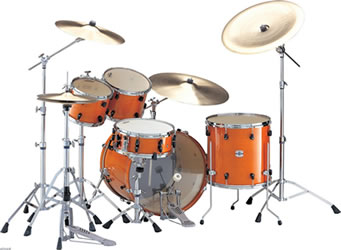
Let us begin our session with a simple 3 tom
drum kit. We'll use one kick drum mic, one snare mic, a single
mic on each tom, and our two overhead mics. Choice of mics here
is not important, and everyone has their favorites. I like to
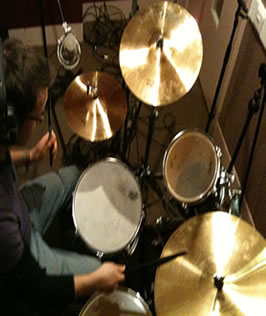
place my overheads directly over the drummer's head, just high
enough so he doesn't bump them when he stands and back far enough
so he can't hit them. I usually space them about 6 - 8 inches
apart and angled 90 degrees relative to eachother. Start by opening
up the overheads. We must absolutely make sure that our overhead
mics themselves are electrically in-phase by checking with the
console switches. The difference will be most dramatic and obvious.
The stereo 'picture' should be quite natural, as the drummer
himself would hear it where he sits. The floor tom is usually
the one element that needs some help, and if need be, one can
move the overhead pair a little closer in the direction of that
particular drum. Next, open the kick mic. While the drummer plays
the kick, flip the kick channel phase switch. Hopefully there
will not be a drastic difference.
 |
Choose what sounds best, but
be prepared to change it later on. Have the drummer just
play a pattern and listen. You should have plenty of snare
already as it is the loudest of all the elements. Have
the drummer play a pattern that includes all the toms.
At this point, you'll probably want to begin opening up
the tom mics slightly to give the toms a little more 'meat',
especially the floor tom. Try to keep it natural. Have
the drummer play a pattern that involves all the cymbals,
both rides and crashes. At this point, you'll decide whether
or not the cymbals are a bit overbearing relative to the
other elements.
If so, start bringing up the tom mics,
then the snare mic. At some point, you'll want to check
the phase of each tom mic with the pair of overheads. This
is where things can start to go crazy. Solo just one tom
mic at a time with the pair of overheads. Flip the phase
switch on the tom mic channel and notice any difference.
I should be obvious which is correct. Do this with each
separate tom mic. Hopefully, all the phase switches will
be in agreement when you have finished. |
I'm sure at this point, someone has said, "you forgot the
hi-hat mic". In all the years I recorded drums, I rarely
if ever used a hat mic. I always put one up for the drummer and/or
client to see, but I never opened it. To me, a close-mic'd hi-hat
sounds like absolute crap....and the hi-hat gets into every other
mic by itself anyway, especially the overheads.
Okay, we've got a rough balance of the drum kit. Now to address
the PANNING of these individual mics. Kick is almost always dead-center.
The overheads are almost always panned hard left-right. This
does NOT mean that we'll hear that stupid full left-to-right
tom turn that every 70's record seem to have. Nobody hears a
drum kit that way unless your sitting with your head under the
drummer's ass! What's really critical - and most misunderstood
- is the panning of the individual tom mics. And here is my trade
secret voodoo method.
Solo up just the overheads. Have the drummer
strike tom #1. Look at your stereo buss meters and observe
the left-right difference. There really won't be much, and
that is natural. Now, solo the #1 tom mic (un-solo the overheads!)
and observe the left-right meter indication again. Turn the
pan-pot for the #1 tom mic until you see the EXACT same relative
difference that you saw with just the overheads! While the
drummer hits just that tom, switch back and forth from solo
overheads to solo #1 tom. the left-right difference should
be identical. You may have to change the input level of the
single tom mic to better see the difference. That's fine -
you can always re-balance later....but most importantly, you
have established the proper "image" or placement
of that #1 tom in the kit mix. Repeat this procedure for each
tom. The end result will be a drum kit with what might seem a
'narrow' stereo image compared to what you may have heard on
other recordings. But keep in mind that the drum kit is just
part of the ensemble and should not dominate the entire stereo
picture. When we go hear a band, the drummer's toms are not set
up the full width of the stage! If you find it necessary to widen
the picture slightly, then pan your tom mics outward accordingly.
I find it necessary at this point to address
the subject of drum mic'ing where live sound in concerned.
I have gotten into more than one heated exchange with sound
men on the use of overhead mics on stage. I personally do not
believe in such an application, and I will back my opinion
and theory by directing your attention to Sir Macca and his
drummer Abe Laboriel, who uses NO overheads on his kit. The
fastest way to ruin the bass sound on a live gig is to allow
it to leak into other mics, and drum overheads because of their
placement, their distance from the kit itself, and usual proximity
to the bass amp are going to be a sponge for all that low-end
slop which gets mixed together with the bass amp mic/direct,
and sent out to the house. Engineers who find it absolutely
necessary to use high-placed overheads would be wise to "chop" or
roll off everything below 800 - 1000Hz with board EQ. Laboriel
uses mics placed under the cymbals where they will capture
much more of the element than any leakage from elsewhere.
In closing (thank God, you say?), it's
still all about the song. Nobody has ever complained about
the drum sound on a hit record!
Chuck Kirkpatrick
has worked on numerous million selling and legendary
recordings. While working as a house engineer at the
now legendary Criteria Studios in Florida Chuck's
impressive ‘60s and early ‘70s, historic engineering
feats included a number of well-known
rock artists. Chuck
currently performs with the group "Rock
And Roll Circus" and can be reached at ckirkp1021@aol.com.
|
|