|
| |
| |
|

By
Steve Weiss
The most misunderstood feature on
a guitar amp.
This month we delve
into the guitar amp Effects Loop, specifically those
in tube amps where distortion is being produced by the
tubes themselves. For those who don't know, the Effects
Loop is where outboard effect units can be connected
to the amps signal flow. In my opinion the Effects Loop
is by far the most misunderstood feature on a guitar
amp. And it's no wonder why. Each amp's loop can differ
in its specifications (impedance and levels) and placement
within the amps signal chain.Effects units themselves
also vary widely in their specs .Therefore the guitar
player is challenged with the task of trying to interface
effect units in a chain (effect box to effect box etc.)
and with the amp itself. Since there is no industry specification
as to levels, impedance and loop location, the guitarist
is left to blindly try and make things work. The result
is very often a significant degradation in tone. If you
think of an effect as analogous to a peripheral device
on a computer, you will see how poor this interface system
is. Computer peripheral devices interface through the
USB port. Any USB device is designed around the standardized
interface specs of the USB port and as long as you load
the appropriate driver it will work correctly on any
computer with a USB port. This is certainly different
from the guitar amp effects loop where your results can
vary from amp to amp.
History of guitar effects
But
we will come back to the loop. Let's first take a
look at the history of guitar effects and a rough
timeline of their development. In the fifties amps
did nothing more than make the guitar louder. By
the early sixties amps featured on board effects
such as Reverb and Tremolo. As the sixties rolled
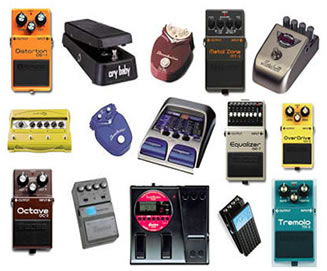
on the Effect Pedals appeared. These were Distortion,
Wa-Wa pedals and Tape Delay units based upon tube
or transistor circuits. Seventies technology advanced
to create the integrated circuit and this brought
analog delays, chorus pedals, envelope filters and
the first digital delays. In the eighties and nineties
digital technology created multi-effect units controlled
by a microprocessor giving guitar players ability
to have racks stuffed with processing units to enhance
(and when overused destroy) their sound. And finally
today's modeling effects that digitally create a
software replica of any effect.
Looking back at the sixties, guitar players had no
choice but to put the effects unit in between their
guitar and the amplifier's input.When the guitar
player plugged his guitar straight into the amp,
there was a clear signal path between the guitar
pickup and the first tube preamp stage. This interface
gave best possible quality of signal and when playing
loud, pushing the power amp section into distortion
it supported varying the amount of distortion by the
manipulation of the guitar's volume control. |
|
Adding
effects in between the guitar and amp put circuitry
into that signal path and removed some of the "Mojo" that
a pure signal path created. Well, you say, when the effects
units were bypassed they were removed from the circuit
and the Mojo should be back. Not true. The way early pedals
operated, they did bypass the guitar signal around the
output of the effect but they also kept the effect's input
circuitry connected to the guitar signal. This presented
a load to the guitar signal that served to degrade the
tone. And if multiple effects were being used they hung
collectively on the guitar signal degrading the tone further.
Of course there were thousands of hit records created using
this setup. It obviously was not an impairment to Hendrix,
so you could say that there were times when these problems
became part of the sound and if one was looking to exactly
create these sounds, these "problems" become
an inherent part of the creation of that sound.
As time went on recording studios became more sophisticated.
Multitrack recording arrived and so did studio effects
that could be added to the recording. Producers began
to add effects to guitar tracks
to enhance them and many players found that when they
went back out and played live they couldn't approach
the sounds of the guitars that were on their records.
In order to look into why this was let's put together
some basic categories of effects so we can understand
how to best apply them. I would divide effects into
four broad categories. 1- distortion effects, 2- time
based effects(reverbs, delays), 3- modulation based
effects (chorus, flange, phase), 4- filter effects(wa,
equalizers). To maximize the use of any of these categories
requires different treatment and placement in the signal
chain. Distortion is the easiest. It is best suited
to be at the amps input and helps drive the amp into
distortion when playing loud.It also imparts its own
set of harmonics that can be adjusted to taste from
the amps tone controls. The difference between studio
and stage becomes apparent with the next groups of
time based effects.
 |
Think
about a tape or analog delay playing into the input
of a guitar amp. The level of each delay repeat
is three DB's lower than the one before it. Therefore
as it plays into the input of the amp each repeat
is putting less signal into the amp and this means
that if the player is driving the amp into distortion
each repeat will sound different than the previous
one since the amp is receiving less signal and
distorting less. This is not to say that this is
a bad or unusable sound,as a matter of fact many
players love this. But let's get back to our recording
studio. The player's guitar is plugged straight
into the amp's input and the producer is adding
delay at the console. Since the guitar player is
sending a consistent signal to his amp his distortion
doesn't vary and since the delay unit at the console
is not distorting anything subsequent to it, each
repeat sounds the same as the last except a little
bit lower in level. So when the guitar player goes
back out live to try to reproduce his record with
a delay going to the input of his amp, he can't
duplicate the sound he recorded in the studio.This
gets worse with modulation based effects. When
a chorus or flange receives a distorted guitar
at its input it gets a rich amount of harmonic
distortion content to act upon. If instead the
chorus or flange is fed directly from the guitar
the effect is not as rich sounding because the
effect doesn't see anything but the sound of a
clean guitar so it doesn't have as much to process. |
The fourth
set of effects are filters. Wa's work great in front
of the amp as it puts a sweepable peak in the frequency response of the guitar and will
influence the sound of the distortion. EQ's in front
of the amp tend to get lost in the distortion and become
ineffective. I'm sure you have noticed when you distort
the power amp stage of an amp the on board tone controls
are way less effective than when the same amp is played
clean. But put an EQ after the distortion and a new
world of tones becomes available to you.
So now guitar players needed
a solution.
They couldn't replicate
the sound of studio effects live and additionally
locating the effects in front of the amp caused them
other problems. This led to the development of the
Effects Loop.This early loop was a set of jacks inserted
in the amp's signal flow between the preamp and power
amp. For those who are unaware, the preamp consists
of several smaller tube stages(usually 12ax7a) that
raise the tiny guitar pickup signal voltage to a
level capable of driving the power amp section. The
power amp section consists of larger tubes(6L6, EL34,
etc.) that produce power to drive the speaker. These
early loops gave a partial solution to the problem.
If you read this column last month you may remember
from our discussion on the Master Volume Control
that the first amps to have master volume controls
didn't have much gain in their preamps so they didn't
sound good at low volumes so the player still needed
to push the output stage to create distortion. Therefore
to move the effects from in front of the amp to a
loop positioned between the preamp and power amp
did very little in regards to having effects post-distortion
as really the effects were still prior to the power
amp where the distortion was being generated.Of course
it did get the effects away from the input of the
amp, but given the chances of impedance and level
mismatches many times it solved one problem and created
another |
|
Come Back To See Part Two in Our
Next Issue, Happy Holidays To All ...
|
| |
Steve Weiss is the owner and main technician
of Steve Weiss Electronics Inc. He is experienced in the
repair of analog and digital musical equipment. This includes
everything from Vintage Tube Amps and Pro Audio equipment
to Digital Keyboards There is also a guitar repair shop
staffed by some of the areas top guitar repair techs. He
is authorized for warranty work on most major brands.
Steve Weiss Electronics is located inside of Sam Ash Music
at 5460 West Sample Road Margate, FL 33073 954-975-3390
Ext 272. Steve has also spent 25 years on the road as a
performing guitarist and is the designer of Primal Guitar
amps that can be seen at Primal
Audio.com Steve can also be reached
at stevew@metromusicmayhem.com |
| |
|
|
|
|