|

By
Chuck Kirkpatrick
My recent in-depth look and experience
with
what has become an industry all by itself in the business of
music recording.
I was once a mastering engineer
myself, long before digital audio and CD's were even heard
of. It was a totally different world; one that dealt more
with physics and mechanical limitations than just keeping
the 'ones' and 'zeros' in line. During my 'first run' at
Criteria (1966-1972), I was assigned to the disc mastering
room when Jack Davis, the resident mastering engineer,
took a leave of absence for several months. Most of our
mastering business was for for a local distributor's pressing
plant that specialized in Latin music. While I did not
relish the idea of being trapped in that 8 X 10 room all
day, away from the big studio and the live recording, the
upside was that I got to learn how to operate the Scully
lathe; a gorgeous piece of machinery costing far more than
most anything in the studio.
I learned some valuable lessons in that
tiny room about phase relationships, stereo matrixing,
and the reason for RIAA curves. When cutting a "master
laquer", one had to be extremely careful about levels.
Too much, and the grooves in the master would "intercut",
leaving you with an un-playable record that would skip
every time the stylus arrived at the intercut area. Too
much high frequencies could easily burn out the cutter
head, costing a ton of money to replace, and putting our
mastering business behind by days. Too much low end, and
the cutting stylus would lift completely off the laquer,
creating what we called a "land"....and the record
would skip.
Master laquers were actually thin discs
of aluminum coated with a thick layer of laquer on each
side. We had to be very careful with these 'blanks' as
even the tiniest of scratches would ruin them. Every time
a master was cut, it had to be visually inspected with
a microscope to check for lands and intercuts. Even one
of these imperfections meant a "blown" laquer,
and you had to start all over again. And God help you if
a bad laquer went to the plant. That might mean thousands
of defective pressings going out to retailers and buyers. |
|
For those in the dark about vinyl duplication:
When a master laquer has been "cut", it is actually
a playable record. But, you did not ever set a needle on it to
listen unless it was a "reference acetate". These "refs" were
all an artist had to take home to listen to until cassettes and
DAT's came along. "Refs" were only good for about
a half dozen plays because the laquer would wear down with each
pass of the needle and the top end (treble) would slowly disappear.
Master laquers sent to the pressing plant were
then coated with nickel via the electrolysis process (look that
up on line). When the thickness was adequate, these metal "stampers" were
then peeled away from the original laquer and were an exact "negative" of
the master. These stampers were then mounted on a machine much
like a giant waffle-iron. Warm vinyl 'donuts' (exactly what they
looked like) were then placed between the two stampers and squeezed
into a flat disc - the record itself! The freshly "pressed" records
were then trimmed (excessive edge material cut off), cooled,
packaged, and shipped.
Those unfamiliar with disc cutting machines hopefully
will at least be familiar with vinyl records and turntables so
as to make the explanation of how they work a little more understandable.
Remembering my last article's reference to energy conversion,
tracking the grooves in a vinyl record cause the needle or stylus
in the turntable phono cartridge to move accordingly. That needle
is attached to a small coil or 'motor', and the movement generates
an electrical signal in the coil which is then amplified and
becomes the sound we hear. Sending the electrical signal back
the opposite way - from the loudspeaker (or microphone) - would
cause the coil in the phono cartridge to move the stylus. Were
than stylus placed on a moving piece of soft plastic or laquer,
it would "cut" a groove in the laquer that represented
the electrical signal. Energy conversion once again.
|
A mastering engineer's job
in the vinyl era was to basically make sure that a proper
laquer master could be produced from the specific program
material on tape without altering the sound to any great
degree. The M.E. would usually listen to all the tracks
or songs and make notes of any inconsistent levels or peaks.
The total time per side had to be determined to set the
LPI control ("lines-per-inch"). During the actual disc cutting,
the M.E. would make appropriate adjustments, "on the
fly". There were definite time limits when cutting
records, usually around 18 to 20 minutes per side. You
could only cut those grooves so close before they would
begin to touch or "inter-cut". In actuality,
there is only one continuous groove, but as it spirals
inward on the disc, it runs parallel to itself. The longer
the time on a 'side', the shallower we had to make the
groove; consequently using less level to keep the groove
from wiggling 'out-of-bounds' and intercutting. There was
a limit and a set standard as to how far in towards the
center of the laquer you could go. The further towards
the center you got, the slower the linear speed of the
disc past the cutting needle. Subsequently, the 'high end'
would begin to drop off rapidly.
About the only similarity in disc cutting then and CD mastering
now was the never-ending quest for "hotter" levels. At Criteria, we were always bringing in
the latest hit records and measuring their levels in the mastering room to see
what the competition was doing. The hottest record I ever saw was the Beatles' "All
You Need Is Love" which measured at peak an unbelievable +13 db! Most 45's
at the time were peaking at around 8 - 9 db. The only tools we had back then
were the compressors and equalizers, and those were used only to keep audio peaks
from screwing up the laquers during cutting. |
There were no "maximizers" or any
other kind of voo-doo gadgets to push up the levels. In today's
digital world, CD mastering is a whole 'nother ball game. The
competition for the loudest, "hottest" album seems
almost out of control, and much of what I hear nowadays is beginning
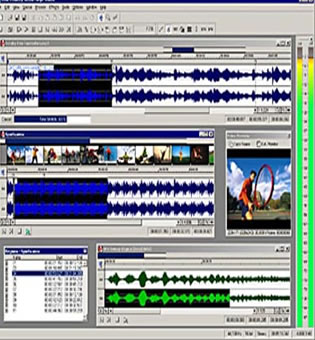
to sound like pink noise. I have imported many CD's into my ProTools
rig just to observe the waveforms, and what I see is shocking.
The waveforms have begun to resemble flat, dark 'ribbons' with
virtually no visible signal below absolute maximum peak. Watching
the peak or VU meters themselves, I see barely any movement at
all. The needles just seem to be painted at "0"!
As previously stated, vinyl
mastering limitations were of a physical nature. You simply
could not make the stylus excursions go beyond a certain
limit without frying the cutter head. And even if you could "maximize" or
smash the audio signal into what we hear now, you'd burn
out the cutter head trying to put that on vinyl.
Unfortunately - like many sound companies
- there is a proliferation nowadays of 'mastering houses'
owned by people who, by virtue of their financial resources,
have become self-appointed ME's with little or no backround
in audio engineering. Many of these houses advertise on-line
and offer free samples of their 'mastering'. I recently
sent a track off my latest album to one such company, just
to see what they would do. What came back to me was almost
laughable. The dynamics were completely gone, and the distortion
was ridiculous.
In an attempt to 'master' my own album,
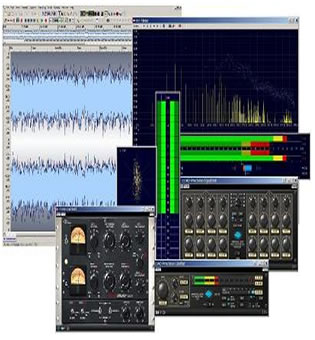
I learned that it takes more than just a couple of plugins
to do the job right. No matter how hard I tried, I could
not match the levels of some professionally mastered commercial
releases I used for a reference. Proper mastering requires
thousands of dollars' worth of exotic gear and a very accurate
monitoring system. The program to be mastered is most often
taken out of the digital domain via very expensive and
accurate D/A converters before it is run through several
different analogue filters and compressors, all of which
have their own 'flavor'. |
 |
Bottom end reacts much differently to compression
than top end, and requires a much different set of parameters
to properly even things out. Often, the audio will be split into
several bands and those are individually compressed, all while
the M.E. carefully monitors phase relationships and peak levels.
Following this compression, the bands are mixed back together
and then run through a final stage of limiting or compression
sometimes using a unit called a 'maximizer' like the Waves L2.
This is an extremely fast "look-ahead" limiter that sees the
'peaks' coming and grabs them before they actually happen. Proper
use of this unit will deliver that "in-your-face" sound
without any distortion or loss of dynamics. The mastered program
is then returned to the digital domain yet again by very accurate
A/D converters and then sent to the replication plant.
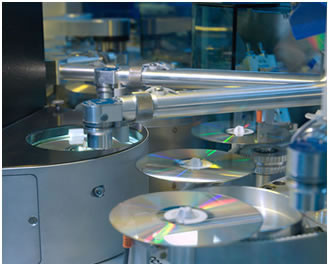
Proper mastering isn't cheap. Some houses charge by the hour
(and tack on an additional fee if you insist on attending the
session). Others charge per song. Either way, a decent mastering
job is going to run you $600 and up for a dozen songs. If you
don't want to spend that much on your album, you're probably
better off not throwing any less than that away on a bad job.
Just make sure all your tunes have basically the same EQ and
level and an overall consistent sound. That will make the ME's
job easier if you do decide to use a mastering house.
Chuck Kirkpatrick
has worked on numerous million selling and legendary
recordings. While working as a house engineer at the
now legendary Criteria Studios in Florida Chuck's
impressive ‘60s and early ‘70s, historic engineering
feats included a number of well-known
rock artists. Chuck
currently performs with the group "Rock
And Roll Circus" and can be reached at ckirkp1021@aol.com.
|
|